

Trends & Analysis
A critical look at where the industry is heading
“Change is the only constant.”
Heraclitus
Every year, the “Gurus” sell you a new Silver Bullet. 2020: “You need a Blog.” 2022: “You need TikTok.” 2024: “You need AI.”
They want you to run on the Trend Treadmill. They want you to panic. They want you to buy their course on “How to Master the New Thing.”
Most businesses die on this treadmill. They spend all their energy chasing the “New” and zero energy building the “Forever.”
The Rule: Stop building for the Trend. Start building for the Behavior. The tools change. The psychology stays the same.
The Obsession That’s Killing Innovation
Section titled “The Obsession That’s Killing Innovation”For years, the holy grail of e-commerce optimization has been increasing conversion rates. And sure, no one’s saying that higher conversions are bad. But focusing solely on squeezing an extra 0.5% can blind you to the bigger picture.
Here’s what everyone’s missing: Consumers aren’t just looking for a website; they’re looking for an experience.
They’ll abandon sites that feel impersonal, generic, or clunky. A fast checkout page alone won’t save you if your site doesn’t inspire trust or connection.
Instead of asking, “How can we drive more sales today?” start asking, “How can we build long-term loyalty through better experiences?”
The Metric Shift:
Old Metric: Conversion Rate (CR). “How many people bought today?”
New Metric: Conversion Resiliency.
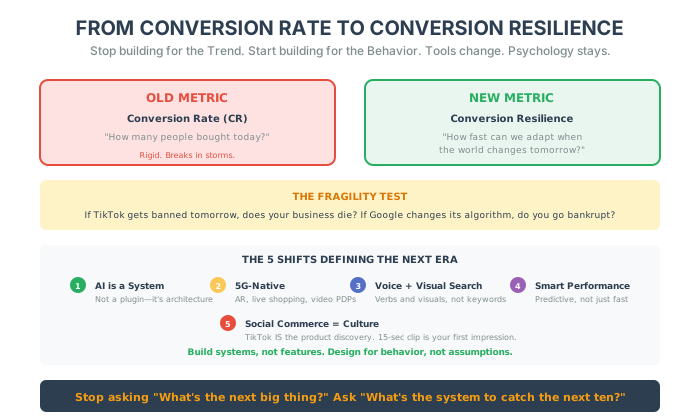
“How fast can we adapt when the world changes tomorrow?”
A bamboo tree survives the hurricane not because it is strong (rigid), but because it is flexible. If TikTok gets banned tomorrow, does your business die? If Google changes its algorithm, do you go bankrupt?
If the answer is “Yes,” you are fragile. You need to build systems that allow you to change your entire acquisition channel in 1 day, not 1 month.
The Difference Between Trends and Leverage
Section titled “The Difference Between Trends and Leverage”When AI-powered personalization comes up, many teams rush to plug in recommendation engines and add chatbot support. Technically? That checks the box.
But strategically? It’s like putting a turbo engine on a bicycle.
If the rest of your stack, user flow, and experience design can’t handle the speed AI brings to the table, you’re setting yourself up for a crash.
The real opportunity isn’t just knowing what’s trending—it’s building infrastructure that lets your brand move faster than your competitors when trends collide.
Most devs are optimizing for the trend—not the impact.
And that’s a massive mistake.
The 5 Shifts Defining The Next Era
Section titled “The 5 Shifts Defining The Next Era”Shift #1: AI Is a System, Not a Feature
Section titled “Shift #1: AI Is a System, Not a Feature”Most dev teams think of AI as a sprinkle of magic dust: slap it on a few product pages, maybe add some NLP for search, and call it innovation.
But the companies winning aren’t treating AI like a plugin.
They’re restructuring their data architecture so personalization happens across every touchpoint:
- Dynamic pricing based on user behavior and context
- Email flows that adjust in real-time based on micro-behaviors
- Checkout experiences that surface the next best action per user
If your database isn’t clean, your AI isn’t smart.
Shift #2: From Mobile-First to 5G-Native
Section titled “Shift #2: From Mobile-First to 5G-Native”There’s a huge difference between a mobile-optimized site and one that feels native to the 5G era.
5G gives us speed—but more importantly, it gives us space to experiment with:
- Augmented reality try-ons that don’t lag
- Live shopping events embedded directly into product pages
- Product exploration through short-form vertical video, not static carousels
If your site still loads like it’s 2022, you’re not competing anymore.
Shift #3: Voice and Visual Search
Section titled “Shift #3: Voice and Visual Search”Developers are still optimizing for keywords.
But voice and visual search require a different mindset:
- You’re not just tagging images—you’re training recognition systems.
- You’re not just writing copy—you’re designing for spoken queries with long-tail intent.
If your dev team isn’t thinking in verbs and visuals, you’re already behind.
Shift #4: Core Web Vitals Are Just Table Stakes
Section titled “Shift #4: Core Web Vitals Are Just Table Stakes”Sure, loading speed and visual stability still matter. But performance is assumed now. It’s not a differentiator anymore—it’s hygiene.
What separates good from great is:
- Preloading intentional assets based on user segment
- Prioritizing predictive interactivity over reactive rendering
- Personalizing performance delivery, not just content
It’s not about being fast—it’s about being smartly fast.
Shift #5: Social Commerce Is Culture
Section titled “Shift #5: Social Commerce Is Culture”Social commerce is exploding, but most devs are still treating it as an “add-on.”
In reality, platforms like TikTok are where product discovery happens.
That means your PDP (product detail page) isn’t your first impression anymore. A 15-second creator clip might be.
So ask yourself:
- Are your dev tools built to support shoppable video embeds?
- Can your stack handle rapid campaign pivots when a trend takes off?
- Do your dev cycles move at the speed of meme culture?
If not, the algorithm will eat you alive.
Experience Downtime (EDT)
Section titled “Experience Downtime (EDT)”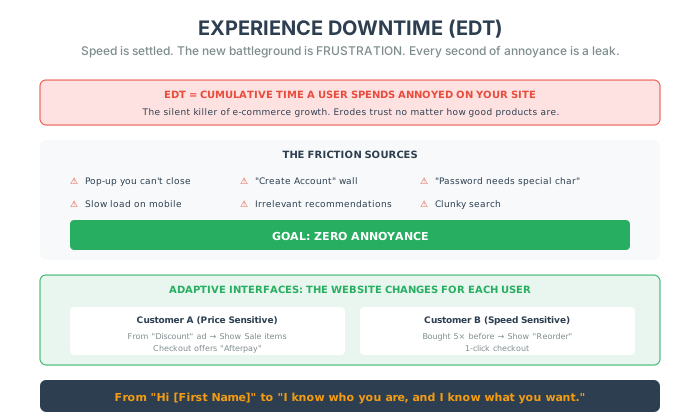
Speed is settled. Everyone is fast. If you are slow, you are dead. We already covered that. The new battleground is Frustration.
I call this Experience Downtime (EDT). It is the cumulative time a user spends annoyed on your site.
- The Pop-up you can’t close.
- The “Create Account” wall before checkout.
- The “Password must have a special character” error.
- Slow load times on mobile.
- Irrelevant product recommendations.
- Clunky search that doesn’t understand what you want.
The Goal: Zero Annoyance. Every second of annoyance is a leak in your bucket.
EDT could be the silent killer of e-commerce growth. Every extra second of EDT erodes trust and loyalty, no matter how good your products are.
To combat this, ask yourself:
- Are your mobile experiences seamless?
- Is your product search intuitive and delivering relevant results?
- Do you proactively address friction points through usability testing?
Reducing EDT isn’t glamorous, but it can quietly revolutionize your bottom line.
Adaptive Interfaces (Hyper-Personalization)
Section titled “Adaptive Interfaces (Hyper-Personalization)”The future is not “One Size Fits All.” The future is Adaptive.
Personalization will move from a nice-to-have to a must-have. But here’s the kicker: most brands are still getting personalization wrong.
Adding a customer’s name to an email subject line isn’t enough. Hyper-personalization means delivering the right product, recommendation, or incentive at the exact moment a customer is ready to act.
Imagine two customers visit your site:
- Customer A (Price Sensitive): The site detects they came from a “Discount” ad. The Homepage highlights “Sale” items. The Checkout offers “Afterpay.”
- Customer B (Speed Sensitive): The site detects they have bought 5 times before. The Homepage shows “Reorder” buttons. The Checkout is 1-click.
The website changes for the user. From “Hi [First Name]” to “I know who you are, and I know what you want.”
What this looks like:
- Dynamic Pricing: Tailored discounts based on browsing behavior or purchase history.
- Predictive Recommendations: AI-driven suggestions based on patterns, not just what’s trending.
- Adaptive Interfaces: Sites that rearrange themselves to prioritize a customer’s preferred categories, styles, or brands.
Think of it as building a digital storefront where every shopper feels like it was designed exclusively for them.
The Accessibility Gold Mine
Section titled “The Accessibility Gold Mine”Here’s a bold prediction: Accessibility will define the top-performing e-commerce sites in the next era.
While many brands treat accessibility as a checkbox (or ignore it entirely), the numbers don’t lie.
Over 1 billion people worldwide live with disabilities, and the global spending power of this market exceeds $1 trillion annually.
Yet, 97% of websites still fail basic accessibility tests.
Brands that prioritize accessible design won’t just avoid lawsuits. They’ll unlock an entirely new audience.
Key accessibility investments:
- Voice navigation
- Keyboard-friendly layouts
- High-contrast visuals
- Screen reader compatibility
- Captioned videos
This isn’t charity. This is business.
First-Party Data: Your Lifeline
Section titled “First-Party Data: Your Lifeline”With privacy laws tightening and third-party cookies fading, your ability to gather and utilize first-party data will be your lifeline.
Build trust with your audience through transparency and offer real value in exchange for their data.
The First-Party Data Stack:
- Email/SMS opt-ins with clear value propositions
- Quiz funnels that collect preferences
- Loyalty programs that track purchase behavior
- On-site behavior tracking (with consent)
- Post-purchase surveys
The brands that own their data will own their future.
Conscious Commerce
Section titled “Conscious Commerce”Customers increasingly care about sustainability, ethical sourcing, and corporate responsibility.
Make these values a core part of your branding and storytelling—and be transparent about your efforts.
What this looks like:
- Carbon-neutral shipping options
- Ethical sourcing documentation
- Sustainability reports
- Charitable partnerships
- Recyclable/minimal packaging
This isn’t just marketing. Younger generations are voting with their wallets.
Building for Lower AOV Environments
Section titled “Building for Lower AOV Environments”Here’s the truth most brands aren’t ready to hear:
The future of e-commerce isn’t about bigger carts. It’s about conversion resiliency—your ability to adapt to user behavior in real time, across devices, channels, and attention spans.
It’s about building for lower AOV environments, where micro-purchases, bundles, and frictionless upsells matter more than “cart value.”
What this means:
- Subscription models with low entry points
- One-click add-ons at checkout
- Bundle builders that feel like games
- Impulse-friendly pricing structures
Stop optimizing for the 20 cart that happens 10 times.
The Anti-Fragile Audit
Section titled “The Anti-Fragile Audit”Look at your roadmap for the next 12 months. Filter every feature through this question: “Is this feature Cool (Trend) or Fundamental (Resilience)?”
- Cool: Adding a Virtual Reality showroom. (High Effort, Unknown Reward).
- Fundamental: Saving credit card details so customers don’t have to type them again. (Low Effort, Guaranteed Reward).
The Rule: If it doesn’t solve a problem you had 5 years ago, it probably won’t matter 5 years from now.
What To Actually Do About It
Section titled “What To Actually Do About It”If you’re leading an e-commerce team, here’s how to think:
-
Stop building features. Start building systems. Tech like AI, 5G, or AR only work when your backend, front-end, and data flows are built to adapt.
-
Design for behavior, not assumptions. Voice and visual search are user-first modalities. If you’re still optimizing around search engines instead of real humans, you’ll fall behind.
-
Build flexible content pipelines. Automated content is only as good as your ability to personalize it at scale. That means tight loops between dev, marketing, and data science.
-
Prioritize learning velocity. The real competitive edge? Shipping small, testing fast, and iterating based on behavior—not boardroom decisions.
-
Double down on first-party data. With privacy laws tightening, your ability to gather and utilize owned data will be your lifeline.
-
Think mobile-first (for real this time). Mobile shopping accounts for the majority of e-commerce revenue. If your mobile experience isn’t as good (or better) than your desktop site, you’re already losing customers.
The End of the Beginning
Section titled “The End of the Beginning”We have covered a lot. Part I: We learned how humans think. Part II: We built the strategy. Part III: We optimized the machine. Part IV: We secured the growth. Part V: We looked at the future.
The future of e-commerce isn’t just faster. It’s smarter, more context-aware, and ruthlessly optimized for convenience.
But the brands that win won’t be the ones who simply follow the trend report. They’ll be the ones who engineer for change itself.
So stop asking, “What’s the next big thing?”
Start asking, “What’s the system that lets us catch the next ten?”
The map is in your hands. You know what to do. The only variable left is You.
Business is hard. It is supposed to be hard. If it were easy, everyone would do it. But you are not everyone.
You have the tools. You have the mindset. Go do the work.
Five things to do this week
Section titled “Five things to do this week”- The “One-Hand” Test: Browse your mobile site with one hand while holding a coffee. If you can’t reach the “Add to Cart” button with your thumb, your design is broken. Fix the “Thumb Zone.”
- Audit Your “EDT”: Go through your checkout. Count every second of “annoyance” (pop-ups, slow loads, account creation). If it’s over 10 seconds, you are bleeding customers. Kill the pop-ups.
- The “TikTok” Drill: If TikTok gets banned tomorrow, do you lose >20% of your traffic? If yes, start diversfying to YouTube Shorts or Pinterest today. Do not build on rented land.
- Check Your Accessibility: Run a free Lighthouse audit (Chrome DevTools). If your Accessibility score is under 90, fix your contrast and alt tags. It’s good for humans and good for SEO.
- Enable “Visual Search”: Upload your top product image to Google Lens. Does it find your product or a competitor’s? If it’s them, optimize your image alt text and metadata.