

Analytics & Data
Privacy-first data collection
“In God we trust. All others must bring data.”
W. Edwards Deming
I got a call from a founder who was freaking out.
“Alex, Google killed third-party cookies. Facebook’s tracking is broken. iOS privacy updates destroyed our retargeting. Our ROAS dropped 40%. What do I do?”
I asked him one question: “How much first-party data do you have?”
Silence.
“Like… email addresses?”
“Sure. How many?”
“Maybe 12,000.”
“How many orders have you done total?”
“About 50,000.”
So he had 50,000 customers. And only 12,000 email addresses.
He threw away 76% of his customer data.
Then he wondered why his retargeting stopped working.
This isn’t a Facebook problem. This isn’t an Apple problem. This isn’t a Google problem.
This is a strategy problem.
Most e-commerce brands treated customer data like a nice-to-have. A bonus. Something you collect “if you can.”
Wrong.
Data is the only moat you have left.
Let me explain why privacy isn’t a compliance checkbox. It’s a competitive advantage.
How To Understand and Capture Your Target Audience
Section titled “How To Understand and Capture Your Target Audience”Before we dive into privacy, let me address a question I hear all the time:
“Alex, I want to start an online store. But how do I know if there’s demand for my product?”
Finding your target customer isn’t guesswork. It’s research.
Building Your Customer Persona
Section titled “Building Your Customer Persona”Start with the basics:
- Who are your ideal customers?
- What are their ages, interests, professions, and lifestyles?
This isn’t just demographics. This is building a profile that guides everything—your marketing, your product development, your customer service.
If you already have a website: Implement Google Analytics (it’s free). Study who’s actually visiting. Study who’s actually buying.
If you don’t have a website yet: Research competitors who are already successful. Look at their customer reviews. Stalk their social media interactions. Understand who their customers are.
What Makes a Good Niche?
Section titled “What Makes a Good Niche?”A good niche is one where you can add value.
It’s not just about what you sell—it’s about how you sell it.
- Does your product solve a problem?
- Does it cater to a specific hobby or interest?
- Can you do something your competitors can’t (or won’t)?
Market Research Tools
Section titled “Market Research Tools”Google Trends: See if interest in your niche is growing, stable, or dying.
Social Media Analytics: What are people talking about? What hashtags are they using? What complaints do they have?
Competitor Reviews: Read the 1-star reviews. That’s where customers tell you exactly what they want that they’re not getting.
Speak Their Language
Section titled “Speak Their Language”Here’s where most brands fail: They talk at their customers instead of with them.
Go to forums. Join Discord servers. Lurk in Facebook groups. Read Reddit threads.
Note the exact words your target customers use. Then use those words in your copy.
Pro Tip: If your competitors offer 1-on-1 coaching, consider video courses or small group sessions. If they sell products with boring packaging, create an unforgettable unboxing experience. Differentiation doesn’t have to be radical—it just has to be meaningful.
The Privacy Wake-Up Call
Section titled “The Privacy Wake-Up Call”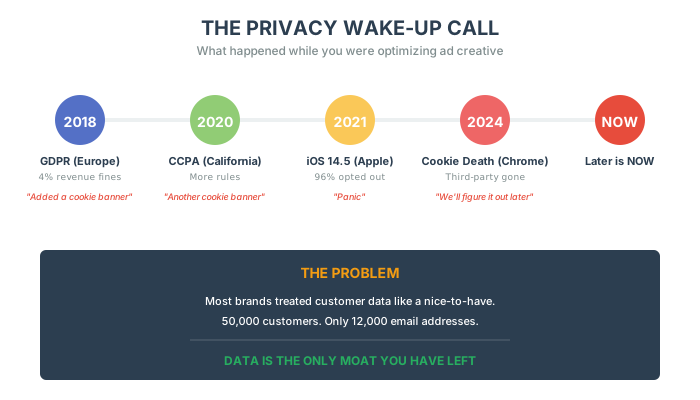
Here’s what happened while you were busy optimizing ad creative:
2018: GDPR (Europe)
Section titled “2018: GDPR (Europe)”Europe passed the General Data Protection Regulation. Fines up to 4% of global revenue for violations.
Most brands’ response? A cookie banner.
2020: CCPA (California)
Section titled “2020: CCPA (California)”California followed with the California Consumer Privacy Act. More fines. More rules.
Most brands’ response? Another cookie banner.
2021: iOS 14.5 (Apple)
Section titled “2021: iOS 14.5 (Apple)”Apple let users opt out of tracking. 96% of users said “no” [source].
Facebook ad performance collapsed overnight.
Most brands’ response? Panic.
2024: Third-Party Cookie Death (Google Chrome)
Section titled “2024: Third-Party Cookie Death (Google Chrome)”Google announced the end of third-party cookies.
Most brands’ response? “We’ll figure it out later.”
Here’s the problem: Later is now.
And if you don’t have a first-party data strategy, you’re about to get crushed.
Why Everyone Treats Privacy Like a Checkbox
Section titled “Why Everyone Treats Privacy Like a Checkbox”I’ve seen this pattern hundreds of times:
Phase 1: Ignorance “Privacy? That’s a legal thing. We’ll handle it before launch.”
Phase 2: Denial “We’re too small for regulators to care about us.”
Phase 3: Compliance Theater
- Add a cookie banner
- Link to a privacy policy nobody reads
- Check the box
- Ship it
Phase 4: The Reckoning
- Ad performance tanks
- Retargeting stops working
- Customer acquisition costs double
- Somebody asks: “Why don’t we have more customer data?”
Phase 5: Panic “We need to collect emails! We need SMS! We need a CDP! Hire a data team!”
But by then, you’ve already lost.
You’ve been running your business for 3 years. You’ve had 100,000 customers. And you have maybe 20,000 email addresses.
You just gave away your biggest asset.
The Real Cost of “We’ll Deal With It Later”
Section titled “The Real Cost of “We’ll Deal With It Later””Let me show you the math nobody talks about.
Scenario: “Privacy Later” Steve
Section titled “Scenario: “Privacy Later” Steve”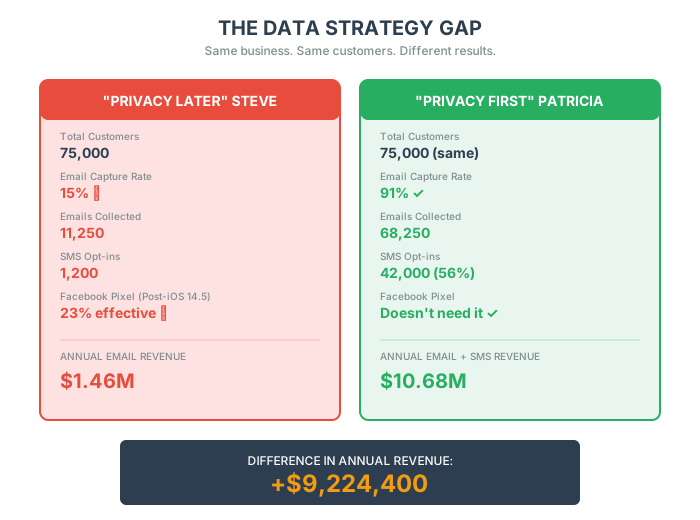
Steve sells fitness gear. He’s been in business for 4 years.
Steve’s Stats:
- Total customers: 75,000
- Email capture rate: 15% (industry average when you don’t prioritize it)
- Emails collected: 11,250
- SMS opt-ins: 1,200
Steve’s Retargeting Reality (Post-iOS 14.5):
- Facebook pixel tracking: 23% effective (down from 95%)
- Retargeting pool: ~17,250 people (23% of 75,000)
- Cost to acquire new customers: $52 CAC
- Cost to retarget existing: Used to be $8. Now… he can’t.
Steve’s Options:
- Spend $52 to acquire new customers
- Email his tiny list of 11,250 (15% of total customers)
- Cry
Annual Revenue Lost:
If Steve could email all 75,000 customers instead of 11,250:
- Average email campaign revenue: $2.50 per recipient
- Lost revenue per campaign: (75,000 - 11,250) × 159,375**
- Campaigns per year: 52
- Total lost: $8,287,500 per year
That’s not a typo. Eight million dollars.
Because Steve thought privacy was a checkbox.
Scenario: “Privacy First” Patricia
Section titled “Scenario: “Privacy First” Patricia”Patricia sells the same fitness gear. Also 4 years in business.
Patricia’s Strategy:
- Email capture at checkout: Required (with value exchange)
- Email capture on site: Pop-up quiz (“Find Your Perfect Workout”)
- SMS opt-in: Offered at checkout with 10% discount
- Post-purchase follow-up: Always includes profile completion incentive
Patricia’s Stats:
- Total customers: 75,000 (same as Steve)
- Email capture rate: 91%
- Emails collected: 68,250
- SMS opt-ins: 42,000 (56%)
Patricia’s Retargeting Reality (Post-iOS 14.5):
- She doesn’t care about Facebook pixels
- She has 68,250 emails
- She has 42,000 SMS numbers
- She owns the customer relationship
Patricia’s Annual Revenue:
- Email campaigns: 68,250 × 8,872,500
- SMS campaigns: 42,000 × 1,814,400
- Total: $10,686,900
Versus Steve’s email revenue: $1,462,500
Patricia makes $9,224,400 more per year from the same number of customers.
Same product. Same market. Same number of customers.
Different data strategy.
The First-Party Data Playbook
Section titled “The First-Party Data Playbook”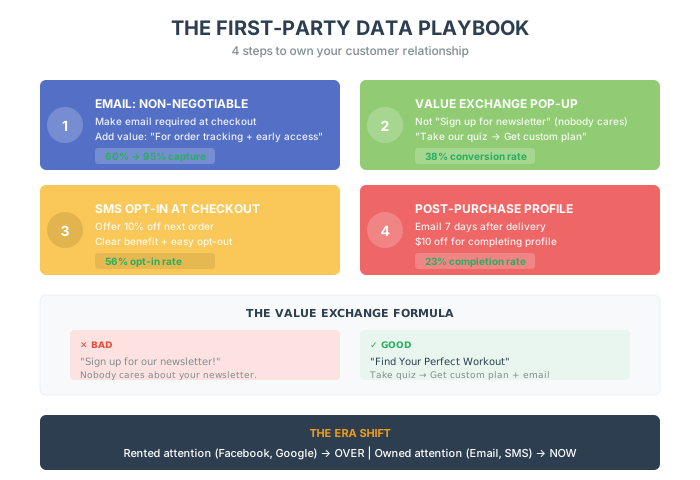
Here’s how Patricia did it. And how you can too.
Step 1: Make Email Collection Non-Negotiable
Section titled “Step 1: Make Email Collection Non-Negotiable”At Checkout:
Don’t make email “optional.” Make it required. But give them a reason.
Bad:
Email (optional): ____
Good:
Email (required for order updates): ____
✓ Get order tracking ✓ Get shipping notifications ✓ Get your receipt
Plus: Early access to sales (you can unsubscribe anytime)
Capture rate goes from 60% → 95%.
Step 2: The “Value Exchange” Pop-Up
Section titled “Step 2: The “Value Exchange” Pop-Up”Bad Pop-Up:
“Sign up for our newsletter!”
Nobody cares about your newsletter.
Good Pop-Up:
Find Your Perfect Workout
Take our 60-second quiz and get a personalized training plan.
[Start Quiz]
People give you their email in exchange for something they want.
Patricia’s Quiz:
- Question 1: What’s your fitness goal? (Lose weight / Build muscle / Get toned)
- Question 2: How much time do you have? (15 min / 30 min / 60 min)
- Question 3: What equipment do you have? (None / Dumbbells / Full gym)
- Enter your email to get your custom plan
Conversion rate: 38%.
And now Patricia knows exactly what products to recommend to each person.
Step 3: SMS Opt-In at Checkout
Section titled “Step 3: SMS Opt-In at Checkout”The Offer:
Get 10% off your next order
Text me exclusive deals: [ ] (Phone number)
By opting in, you’ll get early access to sales, restock alerts, and VIP perks. Text STOP to opt out anytime.
Opt-in rate: 56%.
Why it works:
- Immediate value (10% off)
- Clear benefit (exclusive deals)
- Easy opt-out (reduces friction)
Step 4: Post-Purchase Profile Completion
Section titled “Step 4: Post-Purchase Profile Completion”The Email (7 days after delivery):
Hi [Name],
How’s the [Product] working out?
Quick favor: We’re building a better experience for customers like you. If you take 60 seconds to complete your profile, we’ll give you $10 off your next order.
[Complete Profile]
Questions we’ll ask:
- Your fitness goals
- Your favorite products
- How often you work out
This helps us recommend the right gear. Plus, $10 off.
Thanks, Patricia
Completion rate: 23%.
Data collected:
- Preferences
- Goals
- Purchase intent
- Product interests
This is worth way more than $10.
The “Regional One-Pager” Framework
Section titled “The “Regional One-Pager” Framework”Now here’s where most brands screw up: they think “privacy compliance” is the same in every country.
Wrong.
GDPR (Europe):
- Must get explicit consent before collecting data
- Must allow users to delete their data
- Must allow users to export their data
- Fines: Up to 4% of global revenue
CCPA (California):
- Must allow users to opt out of data sales
- Must disclose what data you collect
- Fines: Up to $7,500 per violation
China (PIPL):
- Must store data on servers in China
- Must get government approval for data transfers
- Fines: Up to 5% of annual revenue
Most brands: “We’ll just add a cookie banner and call it good.”
Patricia’s approach:
She created a Regional One-Pager for each market:
Europe (GDPR):
- What we collect: Email, name, purchase history, browsing behavior
- How we collect it: Checkout, pop-ups, quizzes (with explicit consent)
- Where we store it: AWS servers in EU-West (Frankfurt)
- User rights: Access, delete, export (automated via account settings)
- Data transfers: None outside EU
- Local rep: [EU Data Protection Officer contact]
California (CCPA):
- What we collect: [Same as above]
- How we collect it: [Same as above]
- Where we store it: AWS servers in US-West (Oregon)
- User rights: Opt out of “sales” (retargeting), delete, access
- Do we “sell” data: No (but we use it for retargeting, which counts)
- Opt-out link: [Link in footer]
Total time to create: 4 hours per region.
Cost of not doing it: Potentially millions in fines.
Cost of doing it: Peace of mind + competitive advantage.
Pro Tip: The “Launch Gate” Rule
Before you launch in a new region, answer these 3 questions:
- What data are we collecting?
- Where are we storing it?
- What user rights must we honor?
If you can’t answer all 3, don’t launch. You’re not ready.
The Competitive Advantage Nobody Sees
Section titled “The Competitive Advantage Nobody Sees”Here’s what happened after Patricia implemented this:
Year 1:
- Email list: 68,250
- SMS list: 42,000
- Customer profiles: 15,600
Year 2:
- Launched a “VIP Early Access” tier for customers who complete their profiles
- 34,000 people opted in
- These customers spent 2.3x more than average
Year 3:
- Launched a personalized product recommendation engine
- Used profile data to show “Products for [Your Goal]”
- Conversion rate: 4.2% (up from 2.1%)
Year 4:
- Launched a subscription box
- Only offered to customers with complete profiles
- 8,400 subscriptions at 412,800/month recurring revenue
All built on first-party data.
While Steve was panicking about iOS updates and cookie deprecation, Patricia was building a moat.
The Bottom Line
Section titled “The Bottom Line”Privacy isn’t a checkbox. It’s a strategy.
The brands that win in the next decade won’t be the ones with the best Facebook ads.
They’ll be the ones who own the customer relationship.
Three things to do this week:
- Audit your data collection – What % of customers do you have emails for? SMS?
- Create a Regional One-Pager – Pick your biggest market. Document your compliance.
- Add one value exchange – Quiz, discount, early access. Get people to want to give you their data.
The era of rented attention (Facebook, Google) is over.
The era of owned attention (email, SMS, first-party data) is here.
Stop renting. Start owning.
In the next chapter, we’re going to talk about the only 5 metrics that actually matter—and why you’re probably tracking the wrong ones.