

Fraud & Security
Protecting the bottom line from abuse and bad actors
“Trust is expensive. Betrayal is free.”
Anonymous
You ship a $200 order. Three days later, you get an email: “It never arrived.” You check the tracking. It says “Delivered.” You feel bad. You want to be “Customer Obsessed.” So you send a refund.
Congratulations. You just paid the Nice Guy Tax.
And that customer? They are wearing your shirt on Instagram right now.
Security isn’t about hackers in hoodies stealing your Mainframe. It’s about Susan from Connecticut stealing your inventory because she knows you won’t fight back.
The Two Thieves
Section titled “The Two Thieves”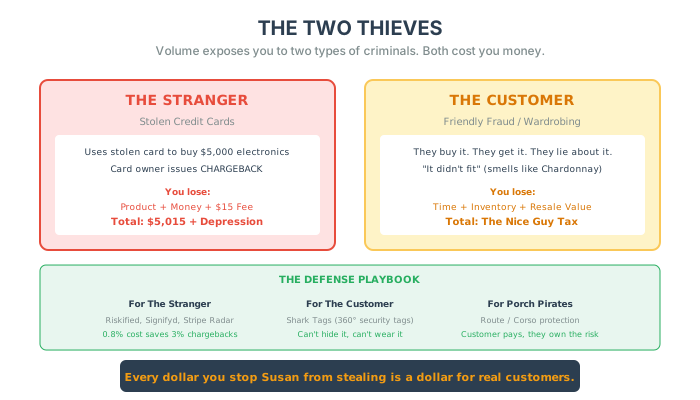
Volume exposes you to two types of criminals.
1. The Stranger (Stolen Credit Cards) They use a stolen card to buy 15 Chargeback Fee. Total Cost: $5,015 + Depression.
2. The Customer (Friendly Fraud) They buy it. They get it. They lie about it. Or my personal favorite: [Wardrobing]. They buy a dress for a Friday night party. They wear it. They tuck the tag in. Monday morning, they return it. “It didn’t fit.” It smells like Chardonnay and regret. But you refund them anyway.
But you refund them anyway.
The Porch Pirate Defense
Section titled “The Porch Pirate Defense”“I didn’t get my package.” This sentence gives e-commerce founders PTSD.
Maybe it was stolen. Maybe they are lying. It doesn’t matter. You are the one who pays.
Unless you flip the risk.
Tools like Route or Corso allow the customer to pay 1-2% extra at checkout for “Package Protection.” If the package is stolen, Route pays for the replacement. Not you.
The Psychology:
- If they pay for insurance, they are covered.
- IF they decline insurance, they accepted the risk.
Now, when they email you: “It didn’t arrive!”, you can say: “I see you declined the protection. We can’t cover stolen items, but here is a 10% coupon.”
You moved the liability from your P&L to their decision.
The “Shark Tag” Protocol
Section titled “The “Shark Tag” Protocol”How do you stop wardrobing without being a jerk? You make the product unwearable until they commit.
Enter the Shark Tag. It is a big, ugly, bright red 360-degree plastic tag that you attach to the front hem of the dress (or the visible part of the product). You cannot hide it. You cannot tuck it.
The Policy: “You can try this on. But if you remove this Red Tag, the item is yours forever.”
They can’t wear it to the party with the tag on. So they either keep it (and pay), or they return it (unworn). Wardrobing: Solved.
The Automation defense
Section titled “The Automation defense”For “The Stranger” (Card Fraud), do not try to be Sherlock Holmes. You cannot manually review every order. Use specific Tools:
- Riskified
- Signifyd
- Stripe Radar
The Math: If Riskified costs you 0.8% of revenue, but saves you 3% in chargebacks, it is not an expense. It is a profit center. Turn it on. Set the rules. Sleep at night.
The “Human Detect” Protocol
Section titled “The “Human Detect” Protocol”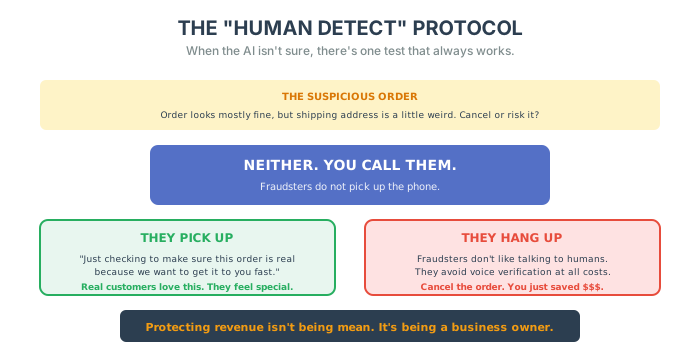
Sometimes, the AI isn’t sure. The order looks mostly fine, but the shipping address is a little weird. Do you cancel it? Do you risk it?
Neither. You call them.
Fraudsters do not pick up the phone. Fraudsters do not like talking to humans.
If they pick up: “Hey, just checking to make sure this order is real because we want to get it to you fast.” Real customers love this. They feel special. Fraudsters hang up.
The Bottom Line
Section titled “The Bottom Line”You lock your front door at night. Why do you leave your digital back door wide open?
Protecting your revenue is not “being mean.” It is being a business owner. Every dollar you stop Susan from stealing is a dollar you can spend on acquiring a real customer.
In the next chapter, we are going to look at the mindset you need to take these savings and blow them up: Growth Philosophy.
Five things to do this week
Section titled “Five things to do this week”- Calculate Your “Nice Guy Tax”: Pull your data from the last 90 days. add up every refund, lost shipment, and chargeback you processed just to “be nice.” Write that number down. That is your budget for the new security tools.
- Turn on the Robots: If you are on Shopify/Stripe, enable the high-risk friction settings. Better yet, install a dedicated tool like Riskified or Signifyd. If your volume is over $1M/year, this is mandatory.
- Buy “Shark Tags”: Go to Amazon or Uline right now. Buy a pack of 360-degree security tags. Put them on your top 5 most-returned apparel items immediately. Watch your return rate plummet.
- The “2-Minute Detective” Rule: Set a filter in your dashboard for orders over $300 with different billing/shipping addresses. Call three of them this week. If they answer, say thank you. If the number is fake, cancel the order.
- Fix Your Return Policy: Rewrite your return page. Add the sentence: “Items must be returned with the Red Security Tag attached and intact.” taking a stand feels scary. Do it anyway.