

AI & Future
Strategic partnerships, the evolving role of paid social, protecting margins when tariffs spike, and the marketing strategies that cost $0 but deliver big results
“The future is already here – it’s just not evenly distributed.”
William Gibson
You walk into a flagship retail store. The lighting is perfect. The displays are sleek. You buy a premium shirt for $50. You feel good. The shirt fits. The store clerk was nice. Two hours later, you get an email from the same brand: “Hey! We saw you looking at shirts. Here is 20% off if you buy now!”
You feel like an idiot. You instantly hate the brand. Why did this happen? Because the “Online Brain” of the business didn’t know what the “Offline Hands” were doing.
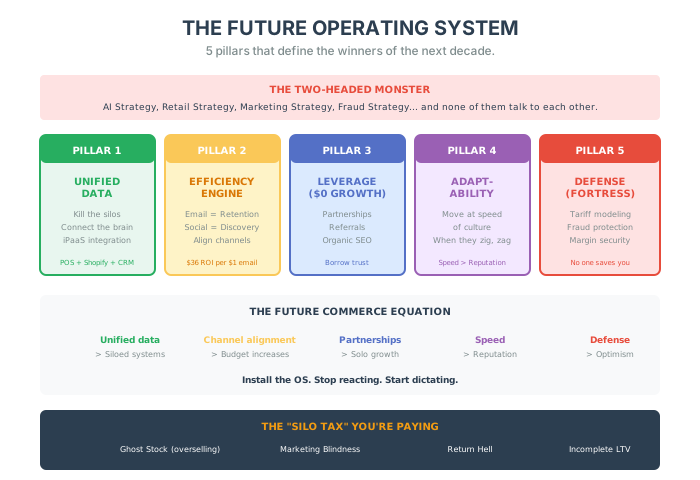
This is the Two-Headed Monster. Most businesses operate with a fractured brain. They have an “AI Strategy.” They have a “Retail Strategy.” They have a “Marketing Strategy.” They have a “Fraud Strategy.” And none of them talk to each other.
This is stupid. To survive the future, you don’t need more “Strategies.” You need a Future Operating System. An OS that integrates your Data, your Growth, your Leverage, your Adaptability, and your Defense.
This chapter is the manual for that Operating System. We are going to break down the 5 pillars that will define the winners of the next decade.
The Future-Readiness Detection Protocol
Section titled “The Future-Readiness Detection Protocol”Before you build the future, you need to know where you stand today. Most brands are behind without realizing it.
Step 1: The Data Unification Audit
Section titled “Step 1: The Data Unification Audit”Can these systems see each other?
| System A | System B | Connected? | 🚨 Red Flag If |
|---|---|---|---|
| POS (Retail) | Shopify | Yes / No | Disconnected |
| Shopify | CRM (Klaviyo) | Yes / No | Disconnected |
| CRM | Customer Service | Yes / No | Disconnected |
| Inventory | All Channels | Yes / No | Disconnected |
| Marketing | Purchase Data | Yes / No | Disconnected |
🚨 Red Flag: If any two critical systems can’t see each other, you’re paying a Silo Tax on every transaction.
Step 2: The Channel Efficiency Audit
Section titled “Step 2: The Channel Efficiency Audit”Answer honestly:
| Question | Yes / No |
|---|---|
| Are you using Email primarily for retention (existing customers)? | |
| Are you using Paid Social primarily for discovery (new customers)? | |
| Do you have separate strategies for each channel? | |
| Can you track revenue attribution per channel? |
🚨 Red Flag: If you’re blasting the same message across all channels, you’re wasting money.
Step 3: The Adaptability Audit
Section titled “Step 3: The Adaptability Audit”In the last 12 months:
| Question | Yes / No |
|---|---|
| Have you tested any AI tools for marketing or operations? | |
| Have you formed any new strategic partnerships? | |
| Have you launched any new product tiers or bundles? | |
| Have you adapted messaging for a new audience segment? |
🚨 Red Flag: If you answered “No” to 3+ questions, you’re falling behind the adaptation curve.
Step 4: The Defense Audit
Section titled “Step 4: The Defense Audit”| Threat | Protected? | 🚨 Red Flag If |
|---|---|---|
| Gift card fraud (rate limiting, captcha) | Yes / No | No protection |
| Tariff exposure (modeled per SKU) | Yes / No | Not modeled |
| Supplier concentration (single source) | Yes / No | 80%+ single supplier |
| Platform dependence (single channel) | Yes / No | 60%+ from one channel |
🚨 Red Flag: Every “No” is a vulnerability that could blow up during a crisis.
Pillar 1: The Unified Foundation (Data & Hybrid Reality)
Section titled “Pillar 1: The Unified Foundation (Data & Hybrid Reality)”If your Shopify dashboard cannot see the transaction that happened in your physical store, your business is broken. You are paying a “Silo Tax” on every transaction.
Most brands dream of opening a physical location. But few realize that the “Hidden Chaos” of disconnected sales channels can quietly kill momentum. When I consult for brands opening their first flagship, the story is always the same. The store looks like a win—sleek displays, enthusiastic customers, products flying off shelves. But behind the scenes? It’s a black hole.
The in-store team does great with foot traffic, but the data goes nowhere.
- No customer records flowing into the CRM.
- No inventory adjustments syncing with the warehouse.
- No sales appearing in the online dashboard. It was as if the store didn’t exist.
The Cost of the Silo Tax:
- Inventory Drift (Ghost Stock): Your system thinks you have 50 units. You actively sell 50 units online. But yesterday, the physical store sold 10. You now have 40. You oversell 10 orders. You have to email 10 customers to apologize. You lose the customer.
- Marketing Blindness: You spend money to retarget people who already bought. You are literally burning cash to annoy your best customers (like the shirt example).
- The “Return” Hell: A customer walks into your NYC store. “I bought this online, can I return it here?” If the clerk says “No, you have to mail it back,” you have failed. The customer creates friction. Friction kills loyalty.
- Incomplete LTV: Customer lifetime value is calculated wrong because you’re missing half the transactions. Your best customers look like average customers.
The Fix: One Brain (iPaaS) You don’t need more tools. You need Data Fidelity. You need an iPaaS (Integration Platform as a Service) that acts as the translator between systems. It becomes the bridge connecting:
- POS: For retail sales.
- Shopify: For online transactions.
- OMS: The command center.
- ERP: The inventory truth.
The 3-Step Integration:
- Make retail indistinguishable from online: Normalize the inputs. The OMS shouldn’t care where the sale happened.
- Trigger identical workflows: Fulfillment, confirmation, and customer creation should happen automatically, whether the order came from a browser or a barcode scanner.
- Unified Marketing Visibility: Push all purchase behavior into tools like Klaviyo. Segment by “NYC Store Shopper” vs. “Website Shopper.”
The Bottom Line: Physical retail isn’t just about sales. It’s about capturing data. If you miss the data, you miss the future.
Pillar 2: The Efficiency Engine (Smart Marketing)
Section titled “Pillar 2: The Efficiency Engine (Smart Marketing)”The lie of the last decade was: “Spend more marketing dollars to get more customers.” The truth is: Misalignment kills ROI. Brands often believe that increasing budget leads to growth, but without alignment, it just leads to waste.
The 5 Factors of Marketing Waste:
- Misalignment: Creating generic campaigns that don’t match the specific audience. Brands invest heavily in broad campaigns that don’t resonate with their customer base.
- Quantity Over Quality: Flooding the market with mediocre content instead of high-value assets. High-quality content that offers value will always outperform large volumes of garbage.
- Ineffective Channels: Spreading budget thin across platforms where your customers aren’t. If your audience engages more on Instagram than Twitter, focus resources accordingly.
- Lack of Personalization: Sending the same blast to everyone. Personalized marketing boosts engagement and conversion rates.
- Ignoring Retention: Obsessing over new customers while ignoring the ones you already paid to acquire. A loyal customer base drives steady sales without excessive spend.
You need to treat your channels like an engine with specific purposes.
1. The Profit Center: Email Marketing Email is not dead. It is your most profitable asset. The Stat: Email marketing delivers an average ROI of 1 spent (Source: Constant Contact). Why? Because it is Owned Media. Unlike social algorithms that limit your reach, email hits the inbox.
- The Strategy: Segmentation. Don’t blast. Segment based on purchase history, browsing behavior, and demographics.
- Case Study (Amazon): Amazon creates hyper-personalized emails. They don’t send “Generic Newsletters.” They send “We saw you looked at a Blender. Here are the 3 best rated Blenders.”
- The Rule: Use Email for Retention. Use it to keep people who already know you.
2. The Discovery Engine: Paid Social Paid Social (Facebook/Instagram/TikTok) is not for loyalty. It is for Discovery. With Mobile Commerce expected to hit $534.18 Billion (40.4% of ecommerce sales), your strategy must be Mobile-First.
The New Rules of Paid Social:
Mobile Creative Optimization:
- Prioritize simple, uncluttered designs that pop on small screens
- Use attention-grabbing cover images and minimal text
- Ensure any text is large enough to read easily
- Add a strong call-to-action that’s easy to click
- Test different image and video aspect ratios
- Leverage carousels and slideshows to showcase more content
The cleaner and more engaging your mobile ads are, the better they will convert. Never assume your desktop creative will translate well.
Shoppable Posts: Reduce friction. Allow the purchase to happen inside the Facebook/Instagram app using Product Tags.
- Drive traffic from social content directly to product pages
- Reduce friction in the purchase process
- Promote newly launched items to warm audiences
- Increase AOV by bundling products
- Grow engagement with interactive tags
UGC & Influencers: Repurpose User Generated Content (UGC) as ads. Authentic content outperforms studio polish.
- Repurpose top-performing organic influencer posts as ads
- Create dedicated campaigns promoting influencer discount codes
- Showcase customers using your products through reviews and imagery
- Develop video ads with influencers highlighting product benefits Note: Always adhere to FTC guidelines for endorsements.
Audience Segmentation: Segment your audience (Demographics, Purchase History, Lifecycle Stage). Stop targeting “Everyone.”
- Demographics: age, gender, income level
- Purchase history: non-buyers, repeat customers, high spenders
- Product category interest: apparel, accessories, shoes
- Shopping patterns: mobile users, desktop users
- Buyer lifecycle stage: new customers, long-time loyalists, at-risk churners
- Engagement level: email subscribers, social followers
Create specific ad sets tailored to each segment. The more relevant your messaging, the better it will resonate.
The Efficiency Trap: If you try to use Social for retention, you lose money (Buying ads for people who already like you). If you try to use Email for discovery, you waste time (Spamming strangers). Know your tools. Align them.
Omnichannel Optimization: Your social ads should integrate tightly with other channels:
- Use the same campaign branding consistently across channels
- Create audience segments based on shopping behavior across channels
- Retarget website visitors with ads that pick up where they left off
- Follow up recent purchases with ads for complementary products
- Link social ads to lead generation offers like email signup forms
Each touchpoint strengthens your relationship with customers.
Pillar 3: The Leverage Multiplier ($0 Growth)
Section titled “Pillar 3: The Leverage Multiplier ($0 Growth)”The best growth strategies cost $0. They rely on Leverage, not Ad Spend. If you have no money, you must use time.
Just because these strategies cost $0 to implement doesn’t mean they’re free—they cost time and effort. For brands just starting or operating with limited budgets, this is often the right trade-off.
Strategy A: The $0 Organic Stack You can grow without ads if you execute on these “Free” foundations:
Social Media Optimization: Tailor content to the platform. Don’t write one piece of content and share it across all accounts. Optimize the core message for each network:
- Facebook: Engaging videos and informative posts
- Instagram: High-quality photos, Reels, and Stories
- Twitter: Short, impactful tweets, GIFs, and Polls
- LinkedIn: Professional articles and industry insights
- TikTok: Short, entertaining videos—entertainment first
- Pinterest: Inspirational and visually appealing pins
- YouTube: High-quality tutorials and vlogs
Pro Tip: Don’t spread yourself thin. Start with one or two networks and build those audiences. Once you get a handle on those, then expand.
SEO & Speed: Speed is an SEO ranking factor. Use Google PageSpeed Insights (Free) to optimize. Use Google Trends and BuzzSumo to find what people are talking about and piggyback on those topics.
Referrals: Word of mouth is powerful. But you have to Incentivize the Ask. Offer rewards. “Give 20.”
- Incentivize referrals with rewards
- Make sure your customers know about it through emails, social media, and your website
- Track performance to optimize the program
Strategy B: Strategic Partnerships (The Goldmine) Stop playing single-player mode. The fastest way to grow is to borrow someone else’s trust. Find companies that have your customer but don’t sell your product.
Why Strategic Partnerships?
- Extend Reach: Access new customer bases that were previously out of reach
- Enhance Credibility: Aligning with established brands enhances your credibility
- Innovate Collaboratively: Leverage partner strengths to innovate products or services
The Partnership Playbook:
- For Apparel Brands: Partner with Designers (Exclusive lines) or Tech companies (AR/VR try-on experiences).
- For Jewelry Brands: Partner with Luxury Goods providers (Affluent customer overlap) or Eco-friendly mining NGOs (Ethical certification).
- For Electronics Brands: Partner with Software companies (Exclusive apps) or Schools/Universities (Institutional sales bundles).
How to Craft Successful Partnerships:
- Identify Potential Partners: Look for companies that complement rather than compete. The ideal partner has a customer base that benefits from your products.
- Set Mutual Goals: Ensure both parties have clear, aligned goals. This alignment prevents conflicts.
- Collaborate on Marketing: Joint marketing campaigns amplify reach and provide better ROI for both partners.
Tools to Find Partners:
- LinkedIn & AngelList: For professional discovery.
- Google Alerts: To track industry movers.
- EventBrite & Meetup: For in-person connections.
- Slack & Trello: For effective communication and project management between teams.
The Metric: Trust Transfer. It is harder to build trust from scratch than to transfer it from a partner.
Pillar 4: The Adaptability Standard (Speed)
Section titled “Pillar 4: The Adaptability Standard (Speed)”Reputation is overrated. Speed is underrated. Look at the breakout stars of 2023/2024. They didn’t win because they were “Better.” They won because they were “Faster” and more adaptable.
Case Study: ChatGPT (Tech Adaptability) Launched in November 2022. It reached 100 Million Users in 2 months. The brands that won were the ones that integrated it immediately—using it for ad copy, email messaging, and content generation. They didn’t wait for permission.
- Experiment with AI to improve your ad copy, email messaging, website content
- Find ethical ways to test and integrate new tech ahead of the curve
Case Study: Starry (Cultural Adaptability) PepsiCo launched Starry to fight Sprite. How? By speaking the language of Gen Z. They didn’t sell “Lemon Lime Soda.” They sold “It Hits Different.” They partnered with Keke Palmer. They focused on outcomes and culture, not just product features.
- Know the audience you want to target and speak their language
- Discover popular figures among your audience and form partnerships
- Outcomes matter more than flashy campaigns
Case Study: Zelle (Payment Adaptability) Mobile P2P payments hit 485.32 Billion (almost half). The lesson: If you don’t offer mobile payments, you lose the younger generation. It’s mandatory.
- Gen Z is increasingly using mobile peer-to-peer payments
- Make sure to provide mobile payment options
- Failing to evolve could lose you younger customers
Case Study: Shein (Operational Adaptability) Shein faced massive reputation issues. Did they die? No. They grew. They partnered with Forever 21. They fixed their biggest pain point: Logistics. They shipped faster from China to the US. Lesson: Operations can beat Reputation.
- Even with a bad reputation, your business can still succeed
- Fix customer pain points by improving logistical issues
- Partner with brands that focus on your target audience
Case Study: Twisted Tea (Category Adaptability) The alcohol market shifted to “No Alcohol / Seltzers.” Twisted Tea Zagged. They launched “Twisted Tea Extreme” (Higher Alcohol). They found their tribe and grew sales by 34% in Q1. Lesson: Don’t follow the trend. Find your specific customer.
- When industry players zig, try to zag
- There is power in differentiation—lean into what makes you unique
- Build a cult following with authenticity over mass marketing
Pillar 5: The Profit Fortress (Defense)
Section titled “Pillar 5: The Profit Fortress (Defense)”You can have Unified Data. You can have Efficient Growth. You can have Leverage. But if you don’t play Defense, you will bleed out. The enemies are Tariffs and Thieves.
Threat 1: The Silent Killer (Gift Card Fraud)
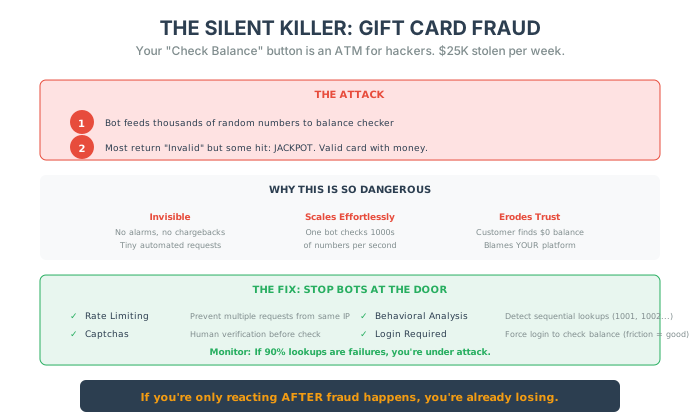
You have a button on your site: “Check Gift Card Balance.” To you, it’s a feature. To a hacker, it’s an ATM.
The Attack: Meet “Alex.” He’s not a hacker. He doesn’t break into databases. He just runs a bot. Every day, his script feeds thousands of random gift card numbers into a retailer’s balance checker. Most return “Invalid.” But every so often? Jackpot. A valid card. With money. By the end of the week, he’s sitting on $25,000 in stolen gift cards—ready to resell, cash out, or drain before the real owner notices.
Why This Is So Dangerous:
- It’s invisible. No alarms. No chargebacks. Just thousands of tiny, automated requests slipping past your security.
- It erodes trust. Customers don’t care how their gift card was drained. They just know it happened on your platform.
- It scales effortlessly. A single bot can check thousands of gift card numbers per second.
- It’s low-risk for attackers. No stolen credit cards. No accounts to hack. Just brute-force guessing.
The Consequence: Your customers try to use their cards and find $0 balance. They blame you. Trust is destroyed.
What Most Companies Do (And Why It Fails): Most retailers only take action after they’ve been hit:
- Blocking suspicious IPs: Fraudsters just rotate to new ones
- Adding more customer support staff: But the money’s already gone
- Assuming it won’t happen again: It will. And next time, it’ll be worse
If you’re only reacting after fraud happens, you’re already losing.
The Fix:
- Rate Limiting: Prevent multiple requests from the same IP.
- Captchas: Stop the bots at the door.
- Behavioral Analysis: Detect sequential lookups (1001, 1002, 1003).
- Login Requirements: Force a login to check a balance. Friction here is good.
- Monitor Traffic: If 90% of your lookups are failures, you are under attack.
Threat 2: The Margin Squeeze (Tariffs & Inflation) When costs spike 12-18% due to tariffs, most founders panic. They raise prices instantly. Customers leave.
I caught up with a founder friend recently. Her margins used to be predictable. Landed cost, labor, COGS—she had them dialed in. Until the tariff hikes hit, and suddenly her top three products were bleeding 12–18% per unit.
She waited a month. Then two. Then she saw one of her biggest competitors pull back entirely from the category. That’s when she knew: this wasn’t a blip—it was the new normal.
So she made a decision: “My margins don’t die on someone else’s timeline.”
The Playbook:
1. Pass Value, Not Cost A lot of founders just jack up prices and hope customers stick around. Not her. She made her product feel more premium first.
- Bundled value-adds that cost almost nothing to include
- Repackaged the offer to highlight outcomes, not features
- Trained her team to tell a better story around the “why now”
Result? She raised prices after increasing perceived value. Retention held steady. Reviews even went up.
2. Tier B Products Same brand, different bill of materials. Her ops team sourced components from domestic partners, even if they didn’t fully match the original spec.
- Lower margin, but protected from tariffs
- Built for subscription customers and price-sensitive channels
- Let her hold price points without bleeding cash
Think of it like the iPhone SE strategy. You don’t have to cannibalize the flagship. You just need options.
3. Dynamic Finance Don’t guess. Hire a fractional CFO to model the tariff impact per SKU. Know your “Walk Away” price before the penalty hits.
- Tariff triggers by country
- Impact per SKU
- Forecasted penalty exposure
Now she sees threats months out and can react before they hit the P&L.
What Most Founders Are Missing: When tariffs hit, most people do this:
- Panic
- Complain
- Blame suppliers
- Delay decisions
- Watch cash evaporate
But the smart ones build systems, not guesses. They realize their job isn’t just to operate the business—it’s to protect the business model.
The Questions to Ask:
- What product assumptions am I clinging to that the market doesn’t care about anymore?
- Where can I deliver more value for less cost?
- How can I turn policy risk into planning power?
Margins are the oxygen of your business. Protect them like it.
Case Study: The Full OS Implementation
Section titled “Case Study: The Full OS Implementation”A premium fitness brand was stuck at $8M/year. They’d tried everything—more ads, new products, influencer campaigns. Nothing moved the needle.
The Situation
Section titled “The Situation”When we ran the detection protocol:
Data Unification Audit:
- Retail POS disconnected from Shopify (🚨)
- Klaviyo couldn’t see in-store purchases (🚨)
- Inventory often oversold online (🚨)
Channel Efficiency Audit:
- Same email blast to all customers
- Paid social targeting existing customers (waste)
- No attribution tracking
Defense Audit:
- No gift card fraud protection
- No tariff modeling (60% of products from single supplier in China)
They were bleeding from a dozen wounds they couldn’t see.
The Intervention
Section titled “The Intervention”Month 1-2: Unified Foundation
- Implemented iPaaS connecting POS, Shopify, and Klaviyo
- Created real-time inventory sync across all channels
- Built unified customer profiles (online + offline behavior)
Month 2-3: Efficiency Engine
- Segmented email list by purchase behavior
- Restructured paid social for discovery only
- Set up proper attribution tracking
Month 3-4: Leverage & Defense
- Partnered with complementary wellness brand (shared audience, different products)
- Implemented fraud protection on gift card system
- Modeled tariff exposure and sourced secondary suppliers
Month 4-6: Adaptability
- Tested AI for email personalization
- Launched “Tier B” product line (domestic sourcing)
- Built rapid-response marketing for trending topics
The Results
Section titled “The Results”| Metric | Before | After (6 months) | Change |
|---|---|---|---|
| Annual Revenue | $8M | $11.2M | +40% |
| Email Revenue | $1.2M | $2.4M | +100% |
| CAC | $48 | $32 | -33% |
| LTV | $142 | $198 | +39% |
| Inventory Accuracy | 72% | 97% | +35% |
The real win: When tariffs increased 18% on their main supplier, they were prepared. Secondary suppliers were already qualified. Tier B products were already selling. Their competitors panicked. They kept growing.
The Lesson
Section titled “The Lesson”They didn’t add more tactics. They installed an Operating System.
The brands that win the next decade won’t be the ones with the biggest budgets. They’ll be the ones with the best systems.
The Bottom Line: Install the OS
Section titled “The Bottom Line: Install the OS”This is the Future of Commerce. It is not one thing. It is The System.
- Unified Data: Kill the silos. Connect the Brain. Physical retail isn’t just about sales—it’s about data fidelity.
- Efficiency: Align Email (Retention) and Social (Discovery). Stop wasting cash on misaligned channels.
- Leverage: Use Partnerships and $0 strategies. Use your time to save your money.
- Adaptability: Move at the speed of culture (Starry) and operations (Shein). When others zig, zag.
- Defense: Protect your margins (Tariffs) and your platform (Gift Card Bots). No one’s coming to save you.
The Future Commerce Equation:
- Unified data > Siloed systems
- Channel alignment > Budget increases
- Partnerships > Solo growth
- Speed > Reputation
- Defense > Optimism
Five things to do this week:
- Audit your data flow – Can your OMS see every transaction, online and offline?
- Review your channel efficiency – Are you using Email for retention and Social for discovery?
- Identify one potential partnership – Who has your customer but doesn’t sell your product?
- Stress-test your fraud defenses – What happens if someone bot-attacks your gift card lookup?
- Model your tariff exposure – Which SKUs are most vulnerable to margin erosion?
Once you install this Operating System, you stop reacting to the market. You start dictating the market.
Now that the System is built, let’s look at how your customers will interact with it. The keyboard is dying. The future is spoken. In the next chapter, we are going to look at the interface of the future: AI & Voice.