

Conversion Strategy
From micro-influencers to landing page optimization
“The best marketing doesn’t feel like marketing.”
Tom Fishburne
I was on a call with a founder who’d just blown $50,000 on an influencer campaign.
“Alex, we paid this Instagram model with 2.4 million followers to post about our product. She posted. We got 147,000 impressions. And you know how many sales we got?”
“How many?”
“Twelve.”
Twelve sales. From 147,000 impressions.
That’s a 0.008% conversion rate.
He paid $4,166 per sale.
His product cost $89.
Let me say that again: He paid 89.
Math is undefeated.
“But Alex, everyone says influencer marketing is the future!”
It is. But you’re doing it wrong.
The problem isn’t influencer marketing. The problem is you’re paying for reach when you should be paying for resonance.
Let me explain why 1,000 real fans beat 1,000,000 fake ones.
The Conversion Strategy Detection Protocol
Section titled “The Conversion Strategy Detection Protocol”Before you spend another dollar on marketing, you need to find where your strategy is broken. Here’s a 30-minute audit that reveals your conversion blind spots.
Step 1: The Traffic Quality Audit
Section titled “Step 1: The Traffic Quality Audit”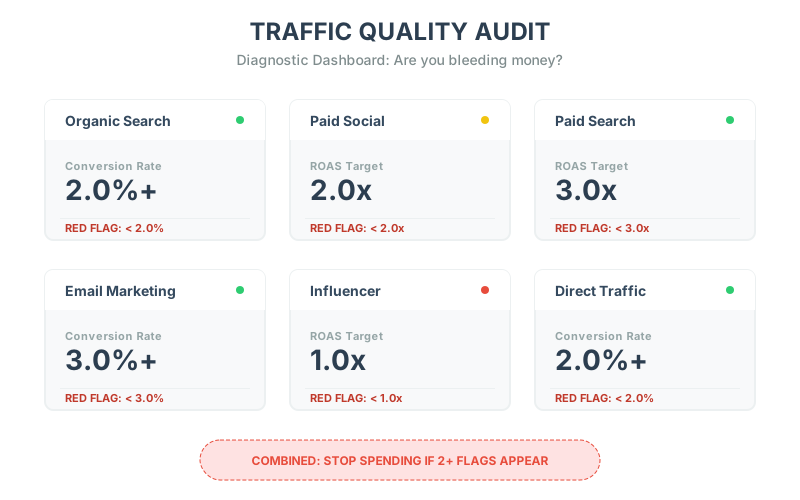
Pull data from your last 30 days:
| Traffic Source | Visitors | Conv Rate | Revenue | Cost | ROAS | 🚨 Red Flag If |
|---|---|---|---|---|---|---|
| Organic Search | ___ | ___% | $___ | $___ | ___x | < 2% conv |
| Paid Social | ___ | ___% | $___ | $___ | ___x | < 2x ROAS |
| Paid Search | ___ | ___% | $___ | $___ | ___x | < 3x ROAS |
| ___ | ___% | $___ | $___ | ___x | < 3% conv | |
| Influencer | ___ | ___% | $___ | $___ | ___x | < 1x ROAS |
| Direct | ___ | ___% | $___ | $___ | ___x | < 2% conv |
Your Best-Performing Channel: ___ Your Worst-Performing Channel: ___
🚨 Red Flag: If any paid channel has ROAS < 1x, you’re literally burning money.
Step 2: The Influencer ROI Audit
Section titled “Step 2: The Influencer ROI Audit”If you’re using influencers, audit honestly:
| Influencer Type | Spend | Reach | Clicks | Sales | ROAS | 🚨 Red Flag If |
|---|---|---|---|---|---|---|
| Mega (500K+) | $___ | ___ | ___ | ___ | ___x | < 1x ROAS |
| Mid (100K-500K) | $___ | ___ | ___ | ___ | ___x | < 2x ROAS |
| Micro (10K-100K) | $___ | ___ | ___ | ___ | ___x | < 3x ROAS |
| Nano (1K-10K) | $___ | ___ | ___ | ___ | ___x | < 4x ROAS |
Calculate your Engagement-to-Sale Ratio:
- Total impressions from influencers: ___
- Total sales from influencers: ___
- Ratio: 1 sale per ___ impressions
🚨 Red Flag: If ratio is > 10,000:1, you’re paying for eyeballs, not buyers.
Step 3: The Landing Page Audit
Section titled “Step 3: The Landing Page Audit”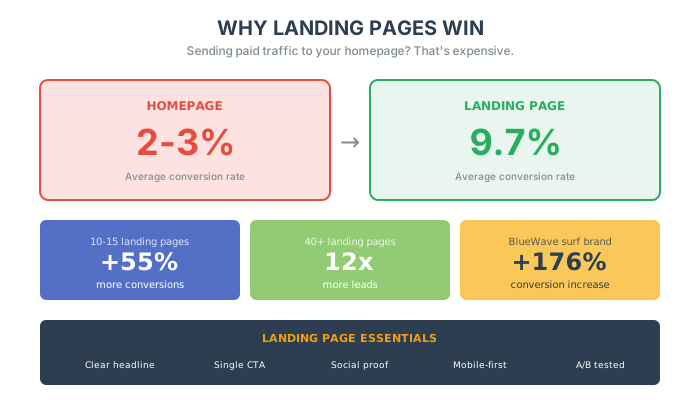
Map where your traffic goes:
| Campaign | Destination | Page Conv Rate | 🚨 Red Flag If |
|---|---|---|---|
| Paid ads | Homepage / Product / Landing | ___% | Homepage at < 2% |
| Email campaigns | Homepage / Product / Landing | ___% | Homepage at < 3% |
| Influencer links | Homepage / Product / Landing | ___% | No dedicated page |
| Organic search | Homepage / Product / Landing | ___% | Bounce > 60% |
Your Landing Page Count:
- Homepage: 1
- Category pages: ___
- Product pages: ___
- Dedicated landing pages: ___
🚨 Red Flag: If you have 0 dedicated landing pages, you’re wasting paid traffic.
Step 4: The Mobile Experience Audit
Section titled “Step 4: The Mobile Experience Audit”Do this yourself. Right now. On your phone:
| Element | Pass/Fail | 🚨 Red Flag If |
|---|---|---|
| Homepage load < 3 seconds | ___ | > 3 seconds |
| Add to Cart visible without scrolling | ___ | Must scroll |
| Checkout fields thumb-friendly | ___ | Tiny tap targets |
| Payment options (Apple Pay, etc.) | ___ | Credit card only |
| Can complete purchase in < 60 seconds | ___ | > 2 minutes |
🚨 Red Flag: If you failed any of these, you’re losing mobile customers (60%+ of traffic).
The 3-Tier Conversion Strategy Framework
Section titled “The 3-Tier Conversion Strategy Framework”Quick Fixes (This Week: 2-8 hours, immediate impact)
Section titled “Quick Fixes (This Week: 2-8 hours, immediate impact)”1. Kill Money-Losing Channels
Look at your Traffic Quality Audit:
- Any channel with ROAS < 1x → pause immediately
- Shift budget to channels with ROAS > 3x
- Don’t spread thin—concentrate on what works
Time: 2 hours (analysis + pause) Impact: Stop bleeding money instantly
2. Create One Dedicated Landing Page
For your highest-spend campaign:
- Clear headline matching the ad
- Single CTA (no navigation distractions)
- Social proof (reviews, trust badges)
- Mobile-first design
Time: 4-6 hours Impact: 2-3x higher conversion than sending traffic to homepage
3. Fix Mobile Checkout Friction
Address the fails from your Mobile Audit:
- Add Apple Pay/Google Pay (one-click checkout)
- Increase tap target sizes
- Remove unnecessary form fields
- Add progress indicator
Time: 2-4 hours Impact: 15-30% improvement in mobile checkout completion
Medium Fixes (This Month: 1-4 weeks, systematic improvement)
Section titled “Medium Fixes (This Month: 1-4 weeks, systematic improvement)”1. Shift from Mega to Micro-Influencer Strategy
If you’re spending on mega-influencers:
- Cut mega budget by 80%
- Redirect to 10-50 micro-influencers (10K-50K followers)
- Pay for performance (affiliate commission, not upfront)
- Target 8%+ engagement rate
Time: 2-3 weeks to recruit and launch Impact: 3-10x improvement in influencer ROAS
2. Build Landing Page System
Create dedicated landing pages for:
- Each product category
- Each major campaign
- Each customer segment
- Seasonal promotions
Time: 2-4 weeks Impact: 50-100% improvement in paid traffic conversion
3. Implement Traffic-Source-Specific Experiences
Customize pages based on where traffic comes from:
- Influencer traffic → show that influencer’s content
- Email traffic → acknowledge their subscriber status
- Retargeting → show products they viewed
- New visitor → show social proof and best sellers
Time: 2-3 weeks Impact: 20-40% improvement in conversion by matching intent
Deep Fixes (This Quarter: 4-8 weeks, competitive advantage)
Section titled “Deep Fixes (This Quarter: 4-8 weeks, competitive advantage)”1. Build a Micro-Influencer Network
Create an always-on influencer program:
- Recruit 50-100 aligned micro-influencers
- Product seeding (free product, no strings)
- Affiliate commissions for performance
- VIP perks for top performers
- Quarterly content cycles
Time: 6-8 weeks Impact: Sustainable acquisition channel with 5-15x ROAS
2. Full Funnel Optimization
Map and optimize every conversion point:
- Awareness → Consideration → Purchase → Retention
- Different content for each stage
- Retargeting sequences by funnel position
- Attribution modeling to understand true ROI
Time: 4-6 weeks Impact: 30-50% improvement in overall conversion efficiency
3. Personalization Engine
Implement dynamic experiences:
- AI-driven product recommendations
- Personalized landing pages by segment
- Dynamic pricing/offers based on behavior
- Predictive intent scoring
Time: 6-8 weeks Impact: 2-3x improvement in returning visitor conversion
The Mega-Influencer Trap
Section titled “The Mega-Influencer Trap”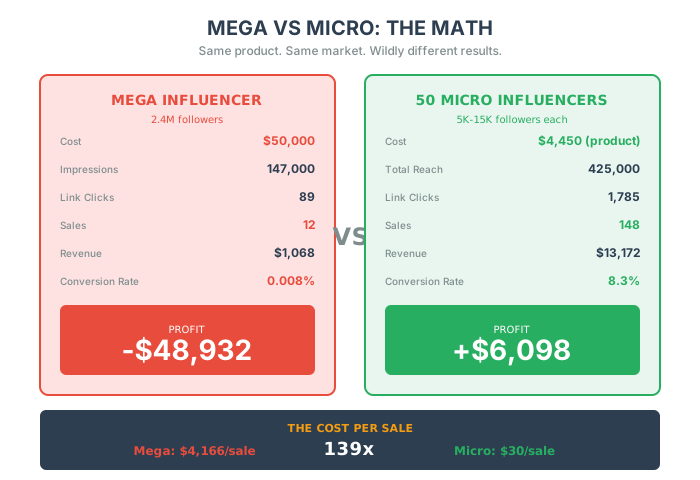
Here’s what happened:
My client found a model with 2.4M followers. Her rate? $50,000 per post.
Expensive, but the math seemed to work:
- 2.4M followers
- Average engagement: 3% (72,000 likes/comments per post)
- If just 1% of engaged people buy → 720 sales
- At 64,080 revenue
- Profit: $14,080
Sounds good, right?
Wrong.
Here’s what actually happened:
The Post:
- Posted at 2pm on a Tuesday
- Caption: “Obsessed with @BrandName! Use code MEGA50 for 50% off! Link in bio 💕”
- Image: Her holding the product (clearly a photoshoot, clearly staged)
The Results:
- 147,000 impressions
- 4,410 likes (3% engagement)
- 127 comments (mostly: “gorgeous!” ”😍” “where’d you get that top?”)
- 89 link clicks
- 12 sales
What went wrong?
Problem #1: Nobody Believed Her
Section titled “Problem #1: Nobody Believed Her”Her followers knew it was an ad. They’ve seen her promote 47 other brands this month. Skincare. Fitness gear. Meal kits. Crypto. NFTs.
She’s not a trusted advisor. She’s a billboard.
Problem #2: Audience Mismatch
Section titled “Problem #2: Audience Mismatch”Her followers are 78% male, ages 18-24, mostly in India and the Philippines [source].
My client’s product? Premium fitness gear for women in the US, ages 28-45.
Zero overlap.
He paid $50,000 to show ads to people who would never buy.
Problem #3: Zero Follow-Through
Section titled “Problem #3: Zero Follow-Through”The model posted once. That’s it.
No stories. No follow-up. No “here’s how I use it.” No authenticity.
Just: “Buy this thing. Here’s a code. Bye.”
Nobody cares.
The Micro-Influencer Advantage
Section titled “The Micro-Influencer Advantage”Now let me show you what actually works.
Sarah’s Micro-Influencer Strategy
Section titled “Sarah’s Micro-Influencer Strategy”Sarah sells the same type of fitness gear. But instead of one mega-influencer, she worked with 50 micro-influencers.
Micro-Influencer Profile:
- Followers: 5,000 - 15,000
- Niche: Fitness moms, yoga instructors, running coaches
- Engagement: 8-12% (way higher than mega-influencers)
- Audience: 85% female, US-based, ages 25-45
Sarah’s Offer:
- Free product (worth $89)
- 20% affiliate commission on all sales
- No upfront payment
Total Cost: 4,450 in free product (50 influencers × $89).
The Campaign:
Each micro-influencer:
- Received the product
- Used it for 2 weeks
- Posted authentic content (no script, no photoshoot)
- Shared their honest experience
- Posted multiple times (feed post + 3-5 stories)
The Results:
Combined Stats:
- Total reach: 425,000 (50 influencers × avg 8,500 followers)
- Average engagement: 10%
- Total engaged: 42,500 people
- Click-through rate: 4.2%
- Clicks: 1,785
- Conversion rate: 8.3%
- Total sales: 148
The Math:
- 148 sales × 13,172 revenue
- Cost of goods: $4,440 (free products)
- Affiliate commissions (20%): $2,634
- Profit: $6,098
Versus mega-influencer profit: -$45,912
Sarah made money. My client lost $45,912.
Same product. Same market. Different strategy.
Why Micro-Influencers Win (Every Time)
Section titled “Why Micro-Influencers Win (Every Time)”Reason #1: Trust
Section titled “Reason #1: Trust”Mega-Influencer: “This celebrity I’ll never meet is holding a product she was paid $50K to hold.”
Micro-Influencer: “Someone like me, who actually uses this product, genuinely recommends it.”
Trust = conversion.
Reason #2: Engagement
Section titled “Reason #2: Engagement”Mega-Influencer Engagement: 1-3%
Why? Because half their followers are bots. Another 30% are passive scrollers. Only 10-20% actually engage.
Micro-Influencer Engagement: 8-12%
Why? Because their audience is real people who actually care about their content.
The Math:
- Mega: 2.4M followers × 3% = 72,000 engaged
- Micro (50 influencers): 425,000 followers × 10% = 42,500 engaged
The mega-influencer looks better. But micro-influencers deliver half the engagement for 1/10th the cost.
Reason #3: Niche Targeting
Section titled “Reason #3: Niche Targeting”Mega-Influencer: Massive audience. But 90% of them don’t care about your product.
Micro-Influencer: Small audience. But 80% of them are exactly your target customer.
Example:
Sarah found a yoga instructor with 8,200 followers.
- 92% female
- 87% US-based
- Average age: 34
- Interest: Yoga, wellness, sustainable products
That’s Sarah’s exact customer.
Her post got:
- 820 likes (10% engagement)
- 47 comments (actual questions about the product)
- 112 link clicks (13.7% CTR)
- 19 sales (17% conversion rate)
One micro-influencer with 8,200 followers delivered 19 sales.
The mega-influencer with 2.4M followers delivered 12 sales.
Wild, right?
The Micro-Influencer Playbook
Section titled “The Micro-Influencer Playbook”Here’s exactly how to do it.
Step 1: Find the Right Micro-Influencers
Section titled “Step 1: Find the Right Micro-Influencers”Don’t look for follower count. Look for:
-
Niche Alignment
- Do they talk about topics related to your product?
- Is their audience your target customer?
-
Engagement Rate
- Likes + Comments ÷ Followers
- Target: 8%+ (anything below 5% = fake followers)
-
Authenticity
- Do they post genuine content or just ads?
- Do followers actually comment and engage?
Where to Find Them:
- Instagram: Search hashtags (#yogainstructor, #fitmom, #runningcoach)
- TikTok: Browse niche content, check follower engagement
- YouTube: Small channels (10K-50K subs) with loyal audiences
- Twitter: Use advanced search for niche keywords
Sarah’s Method:
She made a spreadsheet:
- Column 1: Influencer name
- Column 2: Follower count
- Column 3: Engagement rate
- Column 4: Audience match (1-10 scale)
- Column 5: Contact info
She identified 200 potential influencers. Narrowed it down to 50.
Time spent: 8 hours.
Cost: $0.
Step 2: The Outreach (Don’t Be Creepy)
Section titled “Step 2: The Outreach (Don’t Be Creepy)”Bad Outreach:
“Hey! We’d love to work with you! Free product if you post about us!”
Delete.
Good Outreach:
Subject: Love your content on [specific topic]
Hi [Name],
I’ve been following your content on [topic] for a while, and I love your approach to [specific thing they do].
I run [Brand], and we make [product] specifically for people like your audience. I think your followers would genuinely love it.
Would you be open to trying it out? No strings attached. If you love it and want to share it with your audience, amazing. If not, no worries—keep it anyway.
Either way, I’d love to hear your feedback.
Best, Sarah
Response rate: 62%.
Why it works:
- Personalized (shows you actually follow them)
- No pressure (they can say no)
- No script (authentic content only)
- Clear value (free product, no strings)
Step 3: The Partnership Structure
Section titled “Step 3: The Partnership Structure”Don’t pay upfront. Use performance incentives.
Sarah’s Offer:
- Free product (worth $89)
- 20% affiliate commission on all sales (tracked via unique discount code)
- Bonus: Top 5 performers get $500 cash bonus
Why This Works:
- Zero risk (you only pay for results)
- Aligned incentives (they want to drive sales)
- Quality filter (people who don’t believe in the product won’t participate)
Pro Tip: The “Seeding” Strategy
Send free products to 100 micro-influencers with no ask. Just: “We love your content. We think you’d love our product. No strings attached.”
30-40% will post about it organically (without being asked).
That’s earned media. Zero cost. Infinite ROI.
Step 4: Let Them Create (Don’t Control)
Section titled “Step 4: Let Them Create (Don’t Control)”Bad Brief: “Post this caption, use these hashtags, tag us, link in bio, use our code.”
This kills authenticity.
Good Brief:
Use the product for 2 weeks. If you love it, share your honest experience. Talk about what worked for you. Show how you actually use it. Be yourself.
If you don’t love it, that’s fine too—just let us know what we can improve.
Why This Works:
Authenticity > polish.
People don’t trust scripted ads. They trust real people sharing real experiences.
Step 5: Track Everything
Section titled “Step 5: Track Everything”Metrics to Watch:
- Reach – How many people saw the content
- Engagement – Likes, comments, saves
- Clicks – How many clicked your link
- Conversions – How many bought
- ROI – Revenue ÷ Cost
Sarah’s Dashboard:
| Influencer | Followers | Engagement | Clicks | Sales | Revenue | ROI |
|---|---|---|---|---|---|---|
| @yogamama | 8,200 | 10.2% | 112 | 19 | $1,691 | 19x |
| @runcoach | 12,500 | 9.8% | 87 | 11 | $979 | 11x |
| @fitmom | 6,800 | 11.4% | 95 | 14 | $1,246 | 14x |
Top performers got the $500 bonus. Bottom performers didn’t get invited back.
Over time, Sarah built a roster of 30 proven micro-influencers who consistently drove 8-15x ROI.
The Hybrid Approach (For Brands with Budget)
Section titled “The Hybrid Approach (For Brands with Budget)”If you do have budget for mega-influencers, here’s the smart way to use them:
Use mega-influencers for awareness. Use micro-influencers for conversion.
Example:
- Month 1: Mega-influencer posts (reach: 2M people)
- Month 2-3: 50 micro-influencers post (reach: 400K people, but targeted)
The Strategy:
Mega-influencer = Top of funnel (awareness) Micro-influencers = Bottom of funnel (conversion)
The Results:
People see the mega-influencer post → recognize the brand → see a micro-influencer they trust recommend it → now they buy.
Cost:
- Mega: $50K (one-time brand awareness)
- Micro: 10K in commissions
Revenue: $180K
ROI: 2.8x (vs. mega-only: -0.7x)
The Blind Spot That’s Costing You Sales
Section titled “The Blind Spot That’s Costing You Sales”I was chatting with someone running a Shopify store. Great brand, killer product, solid traffic numbers. But sales? Flatlined.
They’d optimized their homepage, invested in SEO, and tested dozens of Facebook ad creatives. Conversion rate was stuck at 1.3%.
So I asked a simple question: “When was the last time you walked through your own checkout process on mobile?”
Silence.
Then: “Wait… do you mean like, actually buy something?”
Yes. That’s exactly what I meant.
The Bottlenecks You Can’t See in Google Analytics
Section titled “The Bottlenecks You Can’t See in Google Analytics”There are invisible bottlenecks—the micro-moments that kill conversions quietly. You won’t find them in your analytics tool. But they’re felt by your customers in milliseconds.
Here’s what I see all the time:
- Tap targets too small for thumbs
- Coupon codes that don’t apply at checkout
- Shipping costs that only appear after someone enters their info
- “Buy Now” button that scrolls below the fold on mobile
- Auto-playing videos that cover the “Add to Cart” button
None of these show up as red flags in your metrics dashboard. But they’re quietly convincing your best customers to bail—just inches from the finish line.
The 10-Minute Ritual That Saves Thousands
Section titled “The 10-Minute Ritual That Saves Thousands”Once a month, block 10 minutes to do this:
- Visit your own site on your phone
- Start on Instagram or Google (like a real customer would)
- Find a product you’d actually buy
- Go through the checkout flow—taxes, shipping, coupon code, everything
- Take notes every time you feel confused, hesitant, or frustrated
You’ll spot things you’ve become blind to—janky transitions, clunky modals, unclear product descriptions, slow-loading pages right before payment.
Tools don’t fix friction. Awareness does.
Case Study: The Conversion Strategy Overhaul
Section titled “Case Study: The Conversion Strategy Overhaul”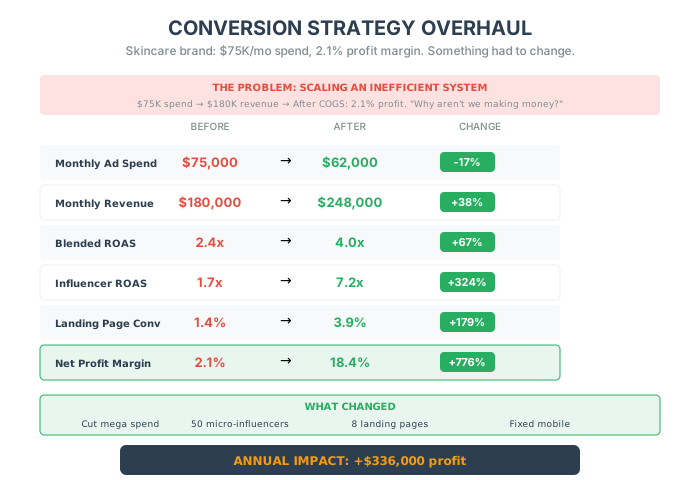
A direct-to-consumer skincare brand was spending $75,000/month on marketing. Revenue was growing, but profit was shrinking.
The Situation
Section titled “The Situation”Their numbers looked impressive on the surface:
- Monthly ad spend: $75,000
- Monthly revenue: $180,000
- Gross margin: 65%
- Looks profitable, right?
Wrong. When we dug in:
- Blended ROAS: 2.4x
- After COGS, shipping, and overhead: Breaking even
- CAC had increased 47% in 12 months
- Profit margin: 2.1% (🚨)
“We’re scaling, but we can’t figure out why we’re not making money,” the founder said.
The problem: They were scaling an inefficient system.
The Detection Phase
Section titled “The Detection Phase”We ran the Conversion Strategy Detection Protocol:
Traffic Quality Audit:
| Source | Visitors | Conv Rate | Revenue | Cost | ROAS |
|---|---|---|---|---|---|
| Meta Ads | 142,000 | 1.4% | $127,000 | $52,000 | 2.4x |
| Google Ads | 38,000 | 2.1% | $31,000 | $18,000 | 1.7x (🚨) |
| Influencer | 67,000 | 0.6% (🚨) | $22,000 | $5,000 | 4.4x |
| 24,000 | 4.2% | $42,000 | $800 | 52x |
🚨 Google Ads ROAS below 2x = losing money after COGS 🚨 Influencer conv rate 0.6% = traffic quality problem
Influencer ROI Audit:
| Type | Spend | Reach | Clicks | Sales | ROAS |
|---|---|---|---|---|---|
| Mega (2 influencers) | $15,000 | 4.2M | 8,400 | 23 | 0.4x (🚨) |
| Mid (5 influencers) | $8,000 | 1.1M | 4,400 | 41 | 1.2x (🚨) |
| Micro (12 influencers) | $2,400 | 180K | 3,200 | 89 | 8.9x |
🚨 Mega-influencer ROAS: 0.4x (lost $11,000) 🚨 Mid-influencer ROAS: 1.2x (broke even) ✅ Micro-influencer ROAS: 8.9x (profitable)
Engagement-to-Sale Ratio:
- Mega: 1 sale per 182,000 impressions (🚨)
- Micro: 1 sale per 2,000 impressions
They were paying 91x more per conversion for mega-influencers.
Landing Page Audit:
| Campaign | Destination | Conv Rate |
|---|---|---|
| Meta Ads | Homepage | 1.4% (🚨) |
| Google Ads | Homepage | 2.1% (🚨) |
| Influencer | Homepage | 0.6% (🚨) |
| Product page | 4.2% |
🚨 All paid traffic went to homepage 🚨 Zero dedicated landing pages 🚨 Homepage conversion: 1.4% vs. product page: 4.2%
Mobile Experience Audit:
- Homepage load: 4.7 seconds (🚨 >3 sec)
- Add to Cart: Required scroll (🚨)
- Payment options: Credit card only (🚨)
- Checkout completion time: 3+ minutes (🚨)
The Problem
Section titled “The Problem”They were:
- Sending expensive traffic to the wrong pages (homepage vs. landing page)
- Spending 88% of influencer budget on mega/mid with 0.4-1.2x ROAS
- Ignoring mobile experience (72% of traffic)
- Over-investing in Google Ads with 1.7x ROAS
The math: Every 0.40. Every 8.90.
They were literally paying to lose money.
The Intervention
Section titled “The Intervention”Week 1-2 (Quick Fixes):
Killed Money-Losing Channels:
- Paused mega-influencer spend (0)
- Cut Google Ads budget 50% (9K)
- Redirected $24K to proven channels
Built First Landing Page:
- Dedicated page for top Meta ad campaign
- Single product focus, no navigation
- Social proof above fold
- Mobile-first design
- Result: Conv rate jumped from 1.4% to 3.8%
Fixed Mobile Checkout:
- Added Apple Pay, Google Pay
- Increased tap targets
- Cut checkout fields from 11 to 6
- Result: Mobile checkout completion +34%
Week 3-6 (Medium Fixes):
Shifted to Micro-Influencer Strategy:
- Paused all mid-tier influencers
- Recruited 25 new micro-influencers (5K-30K followers)
- Offer: Free product + 20% commission (no upfront cost)
- Built tracking with unique codes
Built Landing Page System:
- 8 dedicated landing pages for major campaigns
- Traffic-source matching (influencer traffic → that influencer’s content)
- A/B tested headlines and CTAs
Concentrated Meta Spend:
- Paused underperforming ad sets
- Doubled spend on top 3 performers
- All traffic → dedicated landing pages
Week 7-12 (Deep Fixes):
Built Micro-Influencer Network:
- Scaled to 50 active micro-influencers
- Tiered rewards for top performers
- Monthly content cycles
- Private community for ambassadors
Full Funnel Optimization:
- Retargeting sequences by funnel stage
- Email flows for landing page visitors who didn’t buy
- Attribution modeling to understand true impact
The Results
Section titled “The Results”| Metric | Before | After | Change |
|---|---|---|---|
| Monthly ad spend | $75,000 | $62,000 | -17% |
| Monthly revenue | $180,000 | $248,000 | +38% |
| Blended ROAS | 2.4x | 4.0x | +67% |
| Influencer ROAS | 1.7x | 7.2x | +324% |
| Landing page conv rate | 1.4% | 3.9% | +179% |
| Mobile checkout completion | 42% | 67% | +60% |
| Net profit margin | 2.1% | 18.4% | +776% |
Monthly profit increase: +336,000
The Unexpected Wins
Section titled “The Unexpected Wins”Content library exploded: 50 micro-influencers created 150+ pieces of authentic content per quarter. This became ad creative for Meta campaigns—outperforming their studio content by 2.4x.
SEO benefit: Landing pages with rich content started ranking for long-tail keywords. Organic traffic increased 23% over 6 months.
Customer acquisition cost dropped 31%: Better conversion rates on the same traffic = lower CAC.
The Lesson
Section titled “The Lesson”They didn’t need more budget. They needed better allocation.
The same $75,000/month was either:
- Losing money on mega-influencers and homepage traffic
- Or printing money on micro-influencers and dedicated landing pages
The fix wasn’t spending more. It was spending smarter.
Stop paying for reach. Start paying for resonance. Stop sending traffic to your homepage. Start sending it to conversion-optimized landing pages. Stop measuring impressions. Start measuring sales per dollar spent.
The Landing Page Secret Weapon
Section titled “The Landing Page Secret Weapon”Let me tell you about another blind spot: sending all your traffic to your homepage.
I spoke with a store owner who had a beautiful website, fantastic products, but couldn’t figure out why sales weren’t taking off. The issue? No dedicated landing pages for any of their campaigns.
Why Landing Pages Matter
Section titled “Why Landing Pages Matter”Your homepage is a general introduction to your brand. It’s designed to handle many types of visitors.
A landing page is focused. It targets a specific offer, product, or promotion, and guides visitors toward ONE clear action.
This singular focus means:
- Fewer distractions for the user
- Higher conversion rates for you
The Stats Don’t Lie
Section titled “The Stats Don’t Lie”- Companies with 10-15 landing pages increase conversions by 55%
- Businesses with 40+ landing pages get 12x more leads
- Average conversion rate for landing pages: 9.7% vs. 2-3% for homepages
How to Build High-Converting Landing Pages
Section titled “How to Build High-Converting Landing Pages”1. Clear and Compelling Headline Your headline should be direct, benefit-driven, and tied to the campaign that sent them there.
Bad: “Check Out Our Products” Good: “Boost Your Skincare Routine with Our Vitamin C Serum”
2. One Strong CTA “Buy Now,” “Sign Up,” or “Get 20% Off”—make it bold and direct. Avoid multiple CTAs on a single page.
3. Visual Hierarchy Simple, visually appealing, designed to guide the eye toward the CTA. Use white space and clear imagery.
4. Social Proof Customer reviews, testimonials, and trust badges. Include them to build trust and reduce purchase hesitation.
5. A/B Test Everything Your first landing page won’t be perfect. Test headlines, CTAs, button colors, imagery.
Real Results
Section titled “Real Results”A surf brand called BlueWave started building dedicated landing pages for their top-selling surfboard models, seasonal collections, beginner packages, and newsletter signups.
The result? 176% increase in conversion rates after three months.
The takeaway: if you want results, direct traffic to a landing page tailored to your audience.
The Bottom Line
Section titled “The Bottom Line”You have two choices:
Option 1: Rent Reach
- Pay mega-influencers $50K to show your ad to 2M people who don’t care
- Get 12 sales
- Lose money
- Repeat until broke
Option 2: Build Resonance
- Partner with 50 micro-influencers who reach 400K real people
- Get 148 sales
- Make money
- Scale
Stop chasing vanity metrics (follower count, impressions, reach).
Start chasing conversion metrics (engagement, clicks, sales, ROI).
The future of marketing isn’t buying attention.
It’s earning trust.
And you can’t buy trust from a celebrity.
But you can earn it from 1,000 real fans.
In the next chapter, we’re going to talk about the fundamental truth nobody wants to hear: why discounting is slowly killing your business—and what to do instead.
Five things to do this week
Section titled “Five things to do this week”- Build Your Hit List: Find 20 micro-influencers (5K-15K followers) who actually talk to their audience. Look for 8%+ engagement. Put them in a spreadsheet.
- Send 5 “No Strings” DMs: “Hey, love your content. Want to send you my product. No strings attached. Just think you’d like it.” Do this today.
- Audit Your “Reach” Spend: Are you paying anyone just for impressions? Stop. Shift that budget to affiliate commissions for people who actually drive sales.
- Create ONE Landing Page: Pick your best-selling product. Build a dedicated landing page for it. No header navigation. No distractions. Just the offer. traffic from your next email to this page, not the homepage.
- The “Real Customer” Test: Ask your mom to buy something from your site. Watch her do it. Don’t help her. If she gets stuck, you have a usability problem. Fix it.