

SEO & Traffic
Sustainable organic growth that relies on search intent, not just paid ads
“SEO is not something you do anymore. It’s what happens when you do everything else right.”
Chad Pollitt
I met with a founder last month who was spending $180,000 a year on Facebook ads.
His CAC was 127. He was making $33 profit per customer.
“We’re profitable,” he said. “But barely. And every time Facebook changes the algorithm, we panic.”
I asked him: “How much organic traffic are you getting?”
“About 8,000 visitors a month.”
“How much are you spending on SEO?”
“Nothing. We tried it two years ago. Hired an agency. They did some blog posts and link building. Didn’t see results. Canceled it.”
I pulled up his site. Looked at his product pages.
Product Title: “Women’s Running Shoes – Blue – Size 8”
Meta Description: Blank.
URL: https://brandname.com/products/product-12847
Alt Text on Images: “Image.jpg”
Product Description: 47 words. Zero mentions of what problem it solves. No size guide. No reviews visible above the fold.
This guy was spending 0 on the free traffic sitting right in front of him.
I asked: “What if I told you that you could get 40,000 organic visitors a month—people actively searching for your products—without spending a dollar on ads?”
“I’d say you’re full of shit.”
Six months later, his organic traffic was at 43,000/month. CAC dropped to 66.
He doubled his profit margins without spending an extra dollar on ads.
How?
He stopped obsessing over ads and fixed his search instead.
The Ad Addiction Trap
Section titled “The Ad Addiction Trap”Here’s the dirty secret of e-commerce: Everyone is addicted to paid ads.
Facebook. Google. Instagram. TikTok.
Pour money in. Get traffic out.
It’s predictable. It’s measurable. It’s fast.
But it’s also:
- Expensive
- Fragile (algorithm changes wreck you overnight)
- Competitive (everyone’s bidding on the same keywords)
- Unsustainable (CAC goes up every year)
The worst part?
You’re renting attention.
The second you stop paying, the traffic stops.
You’ve built your entire business on a platform you don’t own.
Organic traffic is different.
Once you rank for a keyword, you get traffic for free. Month after month. Year after year.
It’s an asset. Not a rental.
And most e-commerce brands are completely ignoring it.
Why “SEO Doesn’t Work” (For You)
Section titled “Why “SEO Doesn’t Work” (For You)”I hear this all the time: “We tried SEO. It didn’t work.”
Let me guess what you did:
- Hired an agency
- They wrote 10 blog posts
- They built some backlinks
- You checked your traffic 3 months later
- Nothing changed
- You gave up
That’s not SEO. That’s checking a box.
Real e-commerce SEO isn’t about blog posts (though they help). It’s about making sure that when someone searches for your product on Google, you show up.
The difference:
Blog SEO: “10 Best Running Shoes for Women in 2026”
- Gets traffic
- Doesn’t convert well (they’re researching, not buying)
Product SEO: “Blue Nike Running Shoes Size 8”
- Gets less traffic
- Converts at 4-7% (they’re ready to buy)
Most agencies focus on blog SEO because it’s easier to rank for. They can show you traffic growth in 90 days.
But it’s the wrong traffic.
Product SEO is harder. But it prints money.
The Search Intent Hierarchy
Section titled “The Search Intent Hierarchy”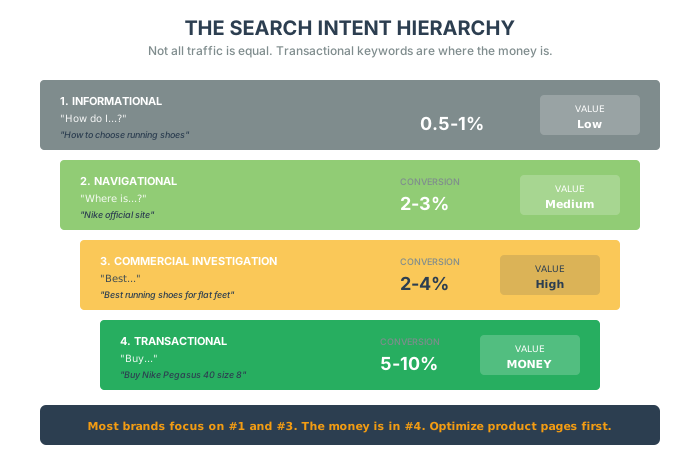
Not all traffic is created equal.
Google searches fall into four categories. Understanding this is the key to e-commerce SEO.
1. Informational (“How do I…?”)
Section titled “1. Informational (“How do I…?”)”Example: “How to choose running shoes”
Intent: Learning. Not buying.
Conversion Rate: 0.5-1%
Value: Low (but good for brand awareness)
2. Navigational (“Where is…?”)
Section titled “2. Navigational (“Where is…?”)”Example: “Nike official site”
Intent: Looking for a specific brand.
Conversion Rate: 2-3%
Value: Medium (unless you’re Nike, you won’t rank)
3. Commercial Investigation (“Best…”)
Section titled “3. Commercial Investigation (“Best…”)”Example: “Best running shoes for flat feet”
Intent: Researching before buying.
Conversion Rate: 2-4%
Value: High (they’re close to buying)
4. Transactional (“Buy…”)
Section titled “4. Transactional (“Buy…”)”Example: “Buy Nike Pegasus 40 size 8”
Intent: Ready to purchase right now.
Conversion Rate: 5-10%
Value: Extremely high (this is money)
Most brands focus on #1 and #3.
Blog posts. Listicles. “Ultimate guides.”
They ignore #4—the searches where people are ready to buy.
Why?
Because transactional keywords are harder to rank for. They’re competitive. And they require perfect product pages.
But that’s where the money is.
The Product Page SEO Framework
Section titled “The Product Page SEO Framework”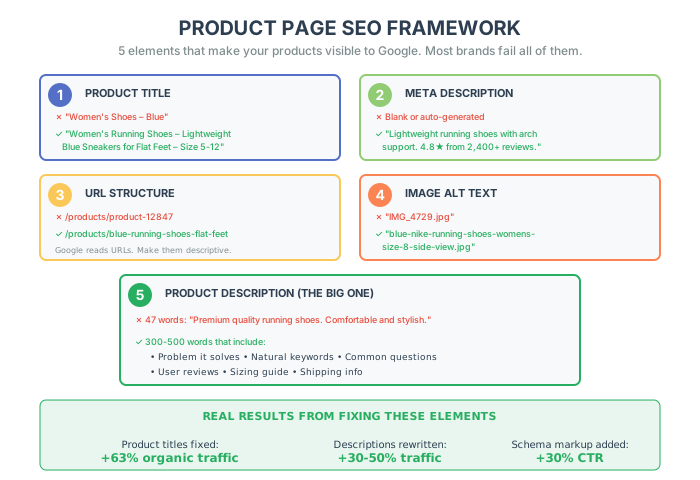
Here’s what most brands get wrong: they think SEO is something the marketing team does.
Wrong.
SEO happens on the product page.
If your product pages aren’t optimized, you’re invisible to Google.
Let me show you the framework.
Element #1: The Product Title
Section titled “Element #1: The Product Title”Bad:
“Women’s Shoes – Blue”
Good:
“Women’s Running Shoes – Lightweight Blue Sneakers for Flat Feet – Size 5-12”
Why it works:
- Specific – “Running shoes” not just “shoes”
- Descriptive – “Lightweight” and “for flat feet” match search intent
- Keyword-rich – Multiple search terms in one title
Real Data:
A footwear brand I worked with changed their product titles from generic to specific.
Organic traffic to product pages increased by 63% in 4 months.
Element #2: The Meta Description
Section titled “Element #2: The Meta Description”This is the text that shows up under your link in Google search results.
Most brands: Leave it blank or auto-generate it.
Smart brands: Write it manually for every product.
Bad (auto-generated):
“Buy this product from our store. Free shipping available.”
Good:
“Lightweight running shoes with arch support for flat feet. Breathable mesh, cushioned sole, and 4.8-star rating from 2,400+ reviews. Free shipping over $50.”
Why it works:
- Benefit-focused – “arch support for flat feet” solves a problem
- Social proof – “4.8-star rating from 2,400+ reviews”
- Call to action – “Free shipping over $50”
This doesn’t directly affect rankings. But it affects click-through rate. And higher CTR = more traffic = Google thinks your page is more relevant = better rankings.
Element #3: The URL
Section titled “Element #3: The URL”Bad:
https://brandname.com/products/product-12847
Good:
https://brandname.com/products/blue-running-shoes-for-flat-feet
Google reads URLs. Make them descriptive.
Element #4: Image Alt Text
Section titled “Element #4: Image Alt Text”Bad:
IMG_4729.jpg
Good:
blue-nike-running-shoes-womens-size-8-side-view.jpg
Google can’t “see” images. It reads alt text.
Plus, if you rank in Google Image Search, that’s free traffic.
Element #5: Product Description (The Big One)
Section titled “Element #5: Product Description (The Big One)”This is where most brands completely fail.
What NOT to do:
“Premium quality running shoes. Comfortable and stylish. Available in multiple colors.”
47 words. Generic. Zero specificity. No keywords. No value.
What TO do:
Write 300-500 words that:
- Describe the product in detail
- Explain what problem it solves
- Include natural keywords
- Answer common questions
- Include user-generated content (reviews)
Example:
Lightweight Running Shoes for Flat Feet – Women’s Size 5-12
Designed specifically for runners with flat feet and overpronation, these lightweight running shoes provide the arch support and stability you need for comfortable, injury-free runs.
Key Features:
- Orthotic-friendly insole with built-in arch support
- Breathable mesh upper keeps feet cool on long runs
- Cushioned EVA midsole absorbs impact
- Durable rubber outsole with high-traction tread
- Available in 6 colors and sizes 5-12
Why Runners Love Them: “I’ve struggled with plantar fasciitis for years. These shoes changed everything. No pain, even after a 10K.” – Sarah M., verified buyer
Sizing Guide: True to size. If between sizes, order up for thicker socks.
Free Shipping on orders over $50. 60-day returns.
Word count: 421 words.
Keywords included: running shoes, flat feet, arch support, lightweight, breathable, cushioned, overpronation
Conversion elements: Reviews, sizing guide, free shipping, returns
This is a product page that ranks and converts.
The Topic Cluster Strategy
Section titled “The Topic Cluster Strategy”Trying to rank for individual keywords is playing SEO on hard mode. What works better is to identify and create content around clusters of related topics and questions.
For example, if you sell hiking shoes, some topic clusters might be:
Buying the right hiking shoes:
- How to choose hiking shoes
- Must-have hiking shoe features
- Most comfortable hiking shoe brands
Caring for hiking shoes:
- How to clean hiking shoes
- How to waterproof hiking shoes
- How to repair hiking shoe soles
Hiking shoe recommendations:
- Best lightweight hiking shoes
- Top-rated women’s hiking shoes
- Good hiking shoes for flat feet
Rather than target generic keywords like “hiking shoes,” create in-depth, personalized content around these clusters. Pack each guide full of value for searchers.
Then interlink everything. Link from your “How to choose hiking shoes” guide to your product pages. Link from product pages to your care guides. Build a web of related content that Google recognizes as authoritative.
The On-Site Search Goldmine
Section titled “The On-Site Search Goldmine”Here’s something most brands completely ignore: your internal search bar.
When someone uses your search bar, they’re telling you exactly what they want.
And most brands screw it up.
The Test:
Go to your site right now. Search for “blue shoes.”
What happens?
Most brands:
- Show 0 results (because products are tagged “navy” or “cobalt”)
- Show 400 results (overwhelming, no filtering)
- Show results but no images (just text)
- Rank them by “newest” instead of “best match”
You just lost a sale.
The Semantic Search Solution
Section titled “The Semantic Search Solution”Most e-commerce platforms treat search as a checkbox feature—type in a keyword, show a list of matching products. The problem? This leaves tons of revenue on the table.
Your search function isn’t a database filter—it’s your best virtual salesperson. When someone uses your search bar, they’re signaling high intent. They’ve told you exactly what they want.
Tools that actually work:
- Algolia
- Klevu
- Searchspring
- Doofinder
These platforms can:
- Handle synonyms automatically (blue = navy = cobalt)
- Correct spelling errors (sheos = shoes)
- Understand product attributes and categories
- Personalize results based on behavior
- Show images and filter by size, price, color
Real Numbers:
A home goods brand implemented Algolia.
Before:
- 18% of searches returned 0 results
- Searchers converted at 3.2%
After:
- 2% of searches returned 0 results
- Searchers converted at 7.1%
Searchers are your highest-intent traffic. Don’t waste them with a broken search bar.
Seasonal Synonym Management
Section titled “Seasonal Synonym Management”Shopping behavior isn’t static. Synonym strategies shouldn’t be either.
Take this scenario: A user searching for “pants” in July might be looking for lightweight chinos. In December, they’re more likely searching for fleece-lined joggers. If your search engine doesn’t adapt to these shifts, you’re missing an opportunity.
Implement dynamic rules:
- In winter, automatically prioritize “thermal joggers” when someone searches for “sweatpants”
- Come spring, revert to lighter joggers and training pants
- During back-to-school, emphasize “uniform trousers” rather than athleisure
The brands that get this right make their search engines feel smart.
The “Zero Results” Report
Section titled “The “Zero Results” Report”Here’s a free goldmine sitting in your analytics: searches that returned zero results.
Every week, pull this report.
Example:
Top “zero result” searches for a furniture brand:
- “velvet couch under $800” (427 searches)
- “small dining table” (312 searches)
- “office chair no wheels” (298 searches)
What this tells you:
- You have demand. 427 people wanted a velvet couch under $800.
- You’re not showing up. Either you don’t have it, or your product pages aren’t optimized for that search.
The Fix:
Option A: Stock the product. Option B: Optimize existing product pages to match that search.
For #1, if you have a velvet couch for 800” to the title and description.
For #2, if you have dining tables, add “small” and “compact” to the relevant products.
Result:
The furniture brand did this for their top 20 “zero result” searches.
Conversions from search increased by 34%.
The Voice Search Revolution
Section titled “The Voice Search Revolution”Voice search has evolved from a novelty to a necessity. By 2024, half of all searches are voice-activated—a staggering shift in consumer behavior.
The way we speak is more conversational than how we type. Voice searches often use full question sentences like “What are the best deals on wireless headphones?”
Key optimizations for voice search:
-
Embrace conversational keywords – Target long-tail phrases like “where can I buy running shoes near me” instead of just “running shoes”
-
Optimize for mobile – Most voice searches occur on mobile. If your site isn’t mobile-friendly, you’re invisible to voice search.
-
Focus on local SEO – Voice questions are often location-based. Keep Google My Business listings updated and localize content.
-
Add FAQ sections – FAQs allow simple conversational content optimization, directly answering common customer questions in an engaging, conversational tone.
-
Implement speakable schema – Schema markup enables search engines to comprehend your content’s context for voice assistants.
Keyword Research That Actually Works
Section titled “Keyword Research That Actually Works”Conducting keyword research is a crucial first step to develop an effective SEO strategy. But most people do it wrong.
Understanding the Framework
Section titled “Understanding the Framework”Step 1: Identify Seed Keywords
Start by brainstorming relevant terms from:
- Your existing product descriptions
- Competitor keywords (use SEMrush to see what they rank for)
- Google’s Keyword Planner
- Amazon autocomplete suggestions
Step 2: Analyze Key Metrics
For each keyword, evaluate:
- Monthly search volume – At least 500-1000 searches per month
- Competitiveness – Pursue low competition long-tail variants
- Relevance – Must match your products
- Commercial intent – Prioritize transactional keywords
Step 3: Organize by Intent
Group your master keyword list:
- Informational – For blog posts and guides
- Navigational – Branded keywords for your domain
- Transactional – For product pages (“buy pink yoga pants”)
Step 4: Expand Research Constantly
Search trends evolve. Revisit your research every 3-6 months:
- Monitor clicks and impressions in Google Search Console
- Use Google Trends to analyze seasonality
- Check “Related Queries” sections for new suggestions
- Set up tracking alerts for high-potential new keywords
The Content That Actually Works
Section titled “The Content That Actually Works”Okay, I said blogs don’t convert. That’s true.
But there is content that converts. You just have to do it right.
Don’t write:
- “10 Best Running Shoes in 2026”
- “Ultimate Guide to Choosing Sneakers”
- “How to Tie Your Shoes”
Do write:
- Buying Guides – “How to Choose Running Shoes for Flat Feet” (then link to your flat-feet shoes)
- Comparison Pages – “Nike Pegasus vs. Adidas Ultraboost” (then link to both)
- Problem/Solution – “How to Stop Shin Splints While Running” (then recommend shoes with proper support)
These pages:
- Rank for commercial intent keywords
- Build trust
- Link to product pages
- Convert at 3-5% (way higher than generic blogs)
Example:
An apparel brand wrote a guide: “What to Wear Hiking in Winter”
They linked to 8 of their products (jackets, boots, gloves).
The page ranks #3 on Google for “winter hiking clothes.”
It gets 4,200 visitors/month.
Conversion rate: 4.1%
That’s 172 sales per month. From one page. Forever.
Go Beyond Plain Text
Section titled “Go Beyond Plain Text”Visual content like images, charts, videos, and infographics helps break up the content while being more engaging and memorable.
Easy visuals to incorporate:
- Product photos and lifestyle imagery
- Comparison charts for features/specs
- Infographics with key statistics
- Video overviews or tutorials
- Interactive size guides and quizzes
Spend time making custom visuals specifically for each guide rather than generic stock images. The effort pays off in engagement and backlinks.
CRO and SEO: Partners, Not Rivals
Section titled “CRO and SEO: Partners, Not Rivals”The other day, I spoke with a founder who’d invested heavily in CRO strategies and SEO efforts—but the two weren’t playing nicely together.
The problem: CRO and SEO seem to pull in opposite directions:
- SEO focuses on bringing in traffic
- CRO focuses on converting traffic
When you optimize for one at the expense of the other, you miss out on their combined power.
The solution: Align them around user intent.
-
Use search intent to guide landing page structure – A high-ranking product page for “best hiking boots” should match the user’s expectation with a comparison chart and a clear path to purchase.
-
Use CRO to amplify SEO traffic – CRO improvements reduce bounce rates and increase dwell time—two metrics Google loves.
-
Track Revenue Per Visitor (RPV) – Instead of treating conversion rate and organic traffic as separate goals, track a metric that bridges the gap.
Preparing for High-Traffic Events
Section titled “Preparing for High-Traffic Events”Here’s a topic that’s crucial but often overlooked: handling massive traffic spikes during sales or promotions.
Your best SEO work will drive traffic. Your best promotions will drive more. But if your site crashes under the load, none of it matters.
The prep work:
-
Scalable Hosting – Ensure your hosting can scale quickly. Cloud solutions like AWS or Google Cloud offer flexibility to scale up resources as needed.
-
Content Delivery Networks (CDN) – Use CDNs to distribute content globally, reducing server load and speeding up load times worldwide.
-
Load Testing – Regularly test to understand your site’s breaking points. Run tests at 10x your expected peak traffic.
-
Virtual Waiting Rooms – Implement a queue system during high-traffic events to manage visitor flow and keep customers informed about wait times.
Real scenario:
An online fashion retailer anticipated a huge influx for their Black Friday sale. By optimizing their checkout process and pre-loading critical pages on a CDN, they managed a 300% increase in traffic without any downtime.
The Link Building Reality
Section titled “The Link Building Reality”Here’s a truth nobody wants to hear: content alone won’t rank you.
You can have the best product descriptions on the planet. Perfect meta tags. Flawless schema markup.
And you’ll still sit on page 3 of Google.
Why?
Because links remain one of the strongest ranking signals according to Google. And most e-commerce brands have zero link strategy.
The Three Types of Links That Matter
Section titled “The Three Types of Links That Matter”1. Internal Links (Free and Underused)
Every page on your site should link to related pages.
- Link product pages to buying guides
- Link blog posts to product categories
- Link from “bestsellers” to individual products
- Link from comparison pages to both options
The rule: No page should be more than 3 clicks from the homepage.
An outdoor brand I worked with audited their internal links. They found 847 product pages that had zero internal links pointing to them.
They fixed it. Those pages saw an average 23% increase in organic traffic within 8 weeks.
2. Editorial Links (Hardest but Most Valuable)
These are links from journalists, bloggers, and publications who genuinely find your content valuable.
How to earn them:
- Create resources that solve problems (size guides, comparison tools, calculators)
- Publish original research or data
- Make something linkable (infographics, interactive tools, quizzes)
A mattress brand created an interactive “Sleep Quiz” that recommended products based on sleep position, temperature preference, and firmness needs.
It got linked from 47 publications in 6 months. Organic traffic increased 156%.
3. Guest Posts (Strategic, Not Spammy)
Focus on sites related to your niche. Write genuinely helpful content. Include one contextual link back to your site.
Do this:
Write “How to Prepare for Your First Marathon” for a running blog, linking to your “Marathon Training Shoe Guide”
Don’t do this:
Pay for links on random sites with no topical relevance
Google can spot paid link schemes. It will penalize you.
The Resource Link Magnet
Section titled “The Resource Link Magnet”Want to earn the highest quality backlinks with minimal ongoing effort?
Create free tools and resources packed with value.
Examples:
- Compare product models side by side
- Build a custom recommendation quiz
- Create an interactive guide for finding perfect size/fit
- Publish industry benchmarks or original data
A hiking gear brand built a “Pack Weight Calculator” that helps hikers estimate their total pack weight based on selected gear.
It took 40 hours to build.
It’s been linked from 89 outdoor websites.
It sends 3,400 visitors/month directly to their product pages.
That’s 89 high-authority backlinks from one piece of content.
Resources like these get discovered and shared, earning high authority links. They showcase your brand as a leader in the space.
The SEO Copywriting Playbook
Section titled “The SEO Copywriting Playbook”Here’s where most brands completely miss: the words on your pages matter more than any technical tweak.
But writing copy for SEO is different from writing ads or email. The intent is different. The psychology is different.
SEO Copy vs. Paid Ad Copy
Section titled “SEO Copy vs. Paid Ad Copy”SEO copy fulfills searchers’ needs for information first. They found you by searching. They want answers.
Ad copy interrupts people who have no clue who you are. You’re grabbing attention, creating desire, driving urgent action.
Both play equally vital roles. But the words for each channel serve different purposes.
The On-Page Optimization Checklist
Section titled “The On-Page Optimization Checklist”1. Hook Searchers with Curated Keyword Phrases
- Research semantic keyword variations using tools like Semrush
- Identify 10-20 core phrases per piece of content
- Work them organically into headings, opening paragraphs, body sections
- Aim for 2-4% keyword density per page
- Compare Google results for your phrases and model what ranking content does
2. Optimize Meta Titles and Descriptions
- Place your primary keyword phrase close to the start of title tags
- Put your core phrase early in the description using problem-focused messaging
- Run A/B tests on meta data to improve click-through rates
3. Link Internal Content Through Contextual Anchor Text
- Use related category pages, product groupings, content pillars to interlink content
- Embed contextual anchor text with targeted phrases
- Be selective on outbound links which leak “link juice”
4. Incorporate Related Media Elements
- Insert well-named images, graphics and videos throughout content pages
- Leverage alt-text on media elements to expand on your semantic topic clusters
- Properly title and transcribe video/audio content
5. Format Content for Scanning
Let’s be honest—no one carefully reads content online anymore. Instead, people scan for what they want.
Make it easy:
- Use descriptive headers and subheaders
- Break up text with bullet points and numbered lists
- Bold key terms and phrases for visual reference
- Include ample paragraph breaks (aim for 2-4 sentences per paragraph)
- Insert relevant images to highlight key points
The Detection Protocol: Is Your SEO Broken?
Section titled “The Detection Protocol: Is Your SEO Broken?”Before you fix anything, you need to know what’s broken.
Here’s a 30-minute audit you can run right now.
Step 1: Check Your Indexing (5 minutes)
Section titled “Step 1: Check Your Indexing (5 minutes)”Go to Google. Type: site:yourdomain.com
What you should see: All your important pages listed.
Red flags:
- 🚨 Your product pages aren’t showing up
- 🚨 Duplicate versions of pages are indexed
- 🚨 Old/deleted pages are still appearing
- 🚨 Your important pages are buried on page 5+
Step 2: Audit Your Top 10 Product Pages (10 minutes)
Section titled “Step 2: Audit Your Top 10 Product Pages (10 minutes)”For each of your 10 best-selling products, check:
| Element | What to Check | Red Flag |
|---|---|---|
| Title | Does it include the product name AND a benefit? | 🚨 Generic or missing |
| Meta Description | Is it written or auto-generated? | 🚨 Blank or boilerplate |
| URL | Is it descriptive? | 🚨 Contains random numbers/IDs |
| H1 Tag | Is there one? Does it match the title? | 🚨 Missing or duplicate |
| Images | Do they have alt text? | 🚨 “Image.jpg” or blank |
| Description | Is it 300+ words? | 🚨 Under 100 words |
| Reviews | Are they visible? | 🚨 Hidden or none |
Step 3: Test Your Site Search (5 minutes)
Section titled “Step 3: Test Your Site Search (5 minutes)”Search for your top 5 products using:
- The exact product name
- A misspelling
- A synonym (“sneakers” for “running shoes”)
- A feature (“waterproof boots”)
Red flags:
- 🚨 0 results for common queries
- 🚨 Irrelevant results ranking first
- 🚨 No images in search results
- 🚨 No filters or facets
Step 4: Check Your Mobile Experience (5 minutes)
Section titled “Step 4: Check Your Mobile Experience (5 minutes)”Open your site on your phone. Try to:
- Find a product
- Add it to cart
- Begin checkout
Time yourself. If any step takes more than 10 seconds, you have a problem.
Step 5: Review Search Console (5 minutes)
Section titled “Step 5: Review Search Console (5 minutes)”Log into Google Search Console. Check:
- Coverage: Any errors or warnings?
- Performance: What queries are you ranking for?
- Core Web Vitals: Any issues flagged?
The Output:
After 30 minutes, you should have a prioritized list of issues. Fix the biggest ones first.
The 3-Tier SEO Fix Framework
Section titled “The 3-Tier SEO Fix Framework”Now that you know what’s broken, here’s how to fix it.
Quick Fixes (This Week: 2-8 hours, 15-25% traffic impact)
Section titled “Quick Fixes (This Week: 2-8 hours, 15-25% traffic impact)”These are the low-hanging fruit. Do them today.
1. Fix Your Top 20 Product Titles
- Time: 2 hours
- Impact: +15-20% organic traffic to those pages
- How: Add specific keywords, benefits, and attributes
2. Write Meta Descriptions for Top 50 Products
- Time: 3 hours
- Impact: +10-15% click-through rate
- How: Include benefit, social proof, and CTA in 155 characters
3. Add Alt Text to All Product Images
- Time: 2 hours (or automate it)
- Impact: +5-10% traffic from Google Image Search
- How: Describe the product: “blue-nike-running-shoes-womens-size-8.jpg”
4. Fix Your Zero-Result Searches
- Time: 1 hour
- Impact: +20-30% conversion from site search
- How: Pull report, add synonyms, update product tags
Medium Fixes (This Month: 1-4 weeks, 25-40% traffic impact)
Section titled “Medium Fixes (This Month: 1-4 weeks, 25-40% traffic impact)”These take more effort but deliver sustained results.
1. Rewrite All Product Descriptions
- Time: 1-2 weeks (depending on catalog size)
- Impact: +30-50% organic traffic to product pages
- How: 300-500 words per product, include keywords, benefits, FAQs, reviews
2. Build 3 Topic Clusters
- Time: 2-3 weeks
- Impact: +40-60% blog/guide traffic
- How: Pick your top 3 categories. Create 5 interlinked pieces each.
3. Implement Smart Search
- Time: 1 week
- Impact: +50-100% conversion from site search
- How: Replace default search with Algolia, Klevu, or Searchspring
4. Add Schema Markup
- Time: 3-5 days
- Impact: +30% click-through rate in search results
- How: Add Product, Review, FAQ, and Breadcrumb schema to all product pages
Deep Fixes (This Quarter: 4-8 weeks, 50-100% traffic impact)
Section titled “Deep Fixes (This Quarter: 4-8 weeks, 50-100% traffic impact)”These are infrastructure investments that pay dividends for years.
1. Complete Site Architecture Overhaul
- Time: 4-6 weeks
- Impact: +50-80% overall organic traffic
- How: Restructure categories, fix internal linking, eliminate orphan pages
2. Launch a Content Hub
- Time: 6-8 weeks
- Impact: +100-200% brand keyword traffic
- How: Build a resource center with guides, tools, and original research
3. Implement Headless Commerce (For Scale)
- Time: 8-12 weeks
- Impact: +20-40% page speed, +15-25% conversion rate
- How: Separate frontend from backend for faster, more flexible pages
4. Build a Link Acquisition Program
- Time: Ongoing
- Impact: +10-20% domain authority per quarter
- How: Guest posts, resource creation, PR outreach, partnership links
Case Study: From 8K to 52K Organic Visitors
Section titled “Case Study: From 8K to 52K Organic Visitors”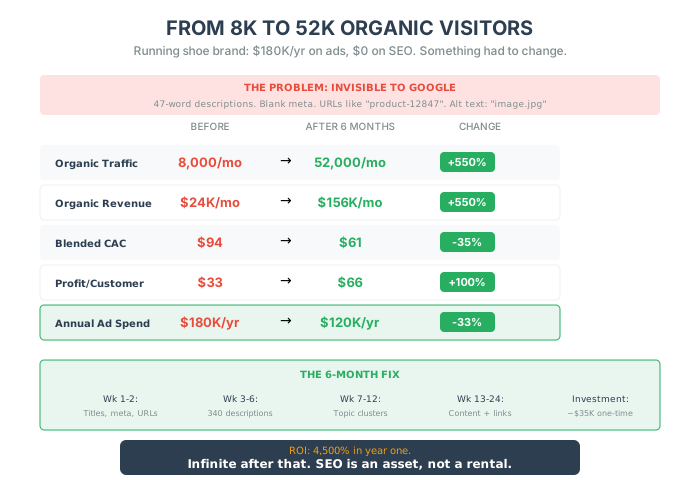
Let me break down exactly what happened with that founder I mentioned at the start.
The Situation:
- $180K/year on Facebook ads
- CAC: $94
- LTV: $127
- Profit per customer: $33
- Organic traffic: 8,000/month
- SEO investment: $0
The Diagnosis:
- Product pages had 47-word descriptions
- No meta descriptions (blank)
- URLs were product IDs, not keywords
- Alt text was all “image.jpg”
- Site search returned 0 results for 22% of queries
- No internal linking between related products
The Fix (6-month timeline):
Weeks 1-2: Quick Fixes
- Rewrote titles for top 100 products
- Added meta descriptions
- Fixed URLs
- Added alt text to all images
Weeks 3-6: Medium Fixes
- Rewrote all 340 product descriptions (hired a freelancer)
- Implemented Algolia for site search
- Added Product schema to all pages
Weeks 7-12: Topic Clusters
- Built 4 topic clusters around main categories
- Created 18 guides/buying guides
- Interlinked everything
Weeks 13-24: Content & Links
- Published 2 guides per week
- Built one linkable resource (a “Shoe Finder” quiz)
- Earned 34 editorial backlinks
The Results (Month 6):
| Metric | Before | After | Change |
|---|---|---|---|
| Organic Traffic | 8,000/mo | 52,000/mo | +550% |
| Organic Revenue | $24K/mo | $156K/mo | +550% |
| CAC (blended) | $94 | $61 | -35% |
| Profit/Customer | $33 | $66 | +100% |
| Ad Spend | $180K/yr | $120K/yr | -33% |
He doubled his profit per customer. And cut his ad spend by 33%.
Total investment in SEO: ~$35K (one-time)
Ongoing organic revenue: $156K/month
ROI: 4,500% in year one. Infinite after that.
The Technical Stuff You Can’t Ignore
Section titled “The Technical Stuff You Can’t Ignore”I’m not going to bore you with technical SEO. But there are 3 things you have to get right.
1. Site Speed
Section titled “1. Site Speed”Google’s rule: Pages should load in under 2.5 seconds.
For every 1 second delay, conversions drop 7%.
Quick wins:
- Compress images
- Use a CDN
- Enable lazy loading
- Minimize JavaScript
2. Mobile Optimization
Section titled “2. Mobile Optimization”58% of searches happen on mobile.
If your site isn’t mobile-friendly, Google won’t rank you.
Test it: Google Mobile-Friendly Test
3. Structured Data (Schema Markup)
Section titled “3. Structured Data (Schema Markup)”This is the code that makes your products show up with:
- Star ratings
- Price
- “In stock” status
- Shipping info
In Google search results.
Products with structured data get 30% more clicks.
Most Shopify themes include this. If you’re on a custom build, hire a dev to add it.
The Bottom Line
Section titled “The Bottom Line”Paid ads are a treadmill. The second you stop running, you stop moving.
SEO is an investment. You do the work once, and it pays you forever.
Most brands:
- $180K/year on ads
- $0 on SEO
- 8K organic visitors/month
Smart brands:
- $120K/year on ads
- $30K one-time SEO investment
- 40K organic visitors/month
- Lower CAC, higher margins, sustainable growth
The SEO Equation:
- Product pages > Blog posts
- Transactional keywords > Informational keywords
- Topic clusters > Individual keywords
- Smart on-site search > Default search
- CRO + SEO together > Either alone
Five things to do this week:
- Audit your product pages – Titles, descriptions, URLs, alt text. Fix the top 20.
- Pull your “zero results” report – What are people searching for that you’re not showing?
- Test your site search – Search for your top products. Does it work? If not, upgrade.
- Build one topic cluster – Pick your best-selling category and create 3-5 interlinked guides.
- Add schema markup – Make your products show rich results in Google.
You’ve already got the product. You’ve already got the site. You’ve already got the traffic potential.
Stop renting attention. Start owning it.
In the next section, we’re diving into Part III: Technical Mastery—the engineering reality of high-performance commerce, from headless architecture to Core Web Vitals.