

Core Strategy
The fundamental economic truths of e-commerce
“In theory, there is no difference between theory and practice. In practice, there is.”
Yogi Berra
I watched a founder burn through $2.4 million in 18 months.
Good product. Beautiful branding. Killer ads. Traffic was pouring in.
And he was hemorrhaging cash.
I asked him: “What’s your unit economics?”
He looked at me like I’d just spoken Mandarin.
“My… what?”
“How much does it cost you to acquire a customer, and how much do they spend with you over their lifetime?”
“Oh, we’re working on that. But we’re growing fast—we just hit $200k in monthly revenue!”
I looked at his P&L.
Revenue: 87 Average Order Value: $64 Repeat Purchase Rate: 4%
He was losing $23 on every customer.
And “growing fast.”
This is what happens when you confuse revenue with profit.
Most e-commerce brands are playing a game they don’t understand. They think the goal is to get more traffic, more sales, more revenue.
Wrong.
The goal is to make money.
And if your core strategy is broken, all the tactics in the world won’t save you.
Let me show you the fundamental economic truths that separate businesses that scale from businesses that implode.
The Three Levers of E-Commerce Economics
Section titled “The Three Levers of E-Commerce Economics”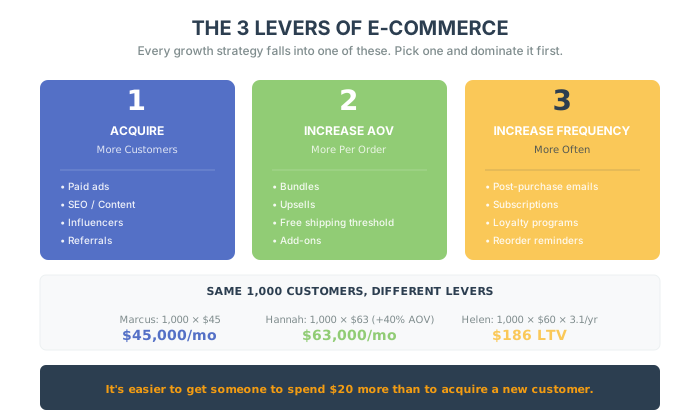
There are only three ways to grow an e-commerce business. Not ten. Not fifty. Three.
1. Get more customers 2. Make them spend more 3. Make them buy more often
That’s it.
Every strategy, every tactic, every “growth hack” you’ve ever heard falls into one of these three buckets.
But here’s what nobody tells you: You can’t pull all three levers at once.
Not when you’re starting out. Not when you’re small. You have to pick one and dominate it.
Let me explain why.
Lever #1: Acquire More Customers (But at What Cost?)
Section titled “Lever #1: Acquire More Customers (But at What Cost?)”Getting more customers sounds obvious. Run more ads. Get more traffic. Close more sales.
But there’s a problem: Acquisition has a price ceiling.
[Customer Acquisition Cost (CAC)]: The total amount you spend to acquire one customer. This includes ad spend, creative costs, agency fees, tools, salaries—everything.
Most brands calculate CAC wrong. They only count the Facebook ad spend and ignore the other 40% of costs.
Here’s the real formula:
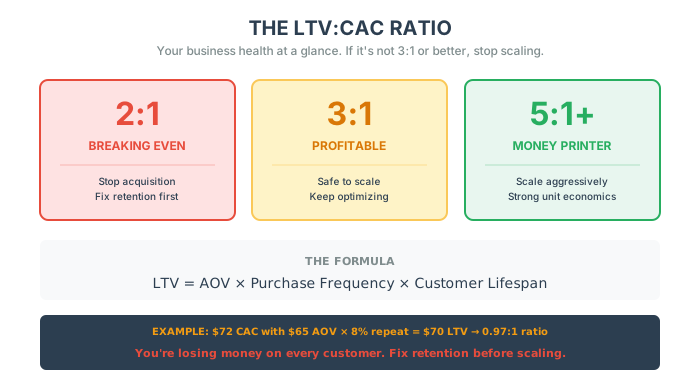
True CAC = (Total Marketing Spend + Tools + Salaries + Creative) / New Customers
Example:
Brand A (the wrong way):
- Facebook ad spend: $50,000
- New customers: 1,000
- “CAC”: $50
Looks great, right?
Brand A (the real way):
- Facebook ad spend: $50,000
- Creative team: $8,000
- Klaviyo + tools: $2,000
- Marketing salaries (allocated): $12,000
- Total spend: $72,000
- New customers: 1,000
- True CAC: $72
Suddenly not so great.
And if their Average Order Value is $65?
They’re losing $7 per customer.
“But Alex, we make it back on repeat purchases!”
Okay. Let’s do the math.
- Repeat Purchase Rate: 8%
- AOV on repeat: $65
- Expected repeat revenue: $5.20
Lifetime Value: 5.20 = $70.20
They’re making $1.80 profit per customer. Before operating expenses.
This is what I call The Acquisition Death Spiral:
- You spend $72 to acquire a customer
- They spend $65
- You lose $7
- You think “We just need more volume!”
- You raise money or take out loans to scale
- You spend $720,000 to acquire 10,000 customers
- You lose $70,000
- Repeat until bankruptcy
The fix isn’t to acquire more customers. The fix is to fix your unit economics first.
Pro Tip: The 3:1 LTV:CAC Rule
Your Customer Lifetime Value should be at least 3x your Customer Acquisition Cost. If it’s not, stop spending on acquisition and fix your retention or pricing.
LTV:CAC = 2:1 → You’re breaking even (bad) LTV:CAC = 3:1 → You’re profitable (good) LTV:CAC = 5:1 → You’re a money printer (great)
Lever #2: Increase Average Order Value (The Multiplier)
Section titled “Lever #2: Increase Average Order Value (The Multiplier)”This is the most underutilized lever in e-commerce.
Most founders obsess over getting more customers. But the real money is in getting each customer to spend more.
Let me show you the math.
Scenario A: “More Customers” Marcus
Marcus runs a DTC skincare brand. His strategy: “We need more traffic!”
- Customers per month: 1,000
- Average Order Value: $45
- Monthly revenue: $45,000
Marcus spends all his time optimizing Facebook ads, tweaking landing pages, running influencer campaigns.
Scenario B: “Higher AOV” Hannah
Hannah runs the same business. Her strategy: “Let’s get people to spend more per order.”
She doesn’t change her traffic at all. She just adds:
- A bundle: “Buy 2, save 15%”
- A free shipping threshold: “Spend $60 for free shipping”
- An upsell at checkout: “Add a travel-size moisturizer for $12?”
Results:
- Customers per month: 1,000 (same as Marcus)
- Average Order Value: $63 (+40%)
- Monthly revenue: $63,000
Hannah makes $18,000 more per month with the same traffic.
That’s $216,000 more per year. From the same 1,000 customers.
And here’s the kicker: It’s easier to get someone to spend $20 more than it is to acquire a new customer.
How to Increase AOV:
- Bundles – “Complete Set: Save 20%”
- Upsells – “Customers also bought…” at checkout
- Free Shipping Thresholds – Psychologically powerful
- Tiered Pricing – Good / Better / Best
- Add-ons – Small, high-margin products (15 range)
Real Example:
A supplement brand I worked with sold protein powder for $55/bottle.
We added one line to checkout: “Add a shaker bottle for $9 (50% off)?”
43% said yes.
AOV went from 59.
Over 2,000 orders/month, that’s $8,000/month in pure profit. From one sentence.
Lever #3: Increase Purchase Frequency (The Retention Game)
Section titled “Lever #3: Increase Purchase Frequency (The Retention Game)”This is the hardest lever. But it’s also the most valuable.
Because here’s the truth: A 5% increase in retention can increase profits by 25-95% [source].
Let me show you why.
Low Frequency Frank:
- Average Order Value: $60
- Purchases per year: 1.2
- LTV: $72
- CAC: $55
- Profit per customer: $17
Frank’s business is a treadmill. He’s constantly acquiring new customers just to maintain revenue.
High Frequency Helen:
- Average Order Value: $60 (same)
- Purchases per year: 3.1
- LTV: $186
- CAC: $55 (same)
- Profit per customer: $131
Helen makes 7.7x more profit per customer.
Same product. Same acquisition cost. Different retention strategy.
How Helen Did It:
-
Post-Purchase Email Sequence
- Day 7: “How’s it working?”
- Day 30: “You’re probably running low. Reorder?”
- Day 60: “Try this complementary product”
-
Subscription Option
- “Subscribe and save 15%”
- 22% of customers opted in
- Retention went from 1.2 → 3.8 purchases/year for subscribers
-
Loyalty Program
- Points for every purchase
- VIP tier at $500 lifetime spend (free shipping + early access)
- Top 10% of customers now spend 4.2x more
The result:
Frank’s business: 17,000/month profit**
Helen’s business: 131,000/month profit**
Same number of customers. 7.7x more profit.
The Pricing Power Paradox
Section titled “The Pricing Power Paradox”Here’s the most counterintuitive truth in e-commerce: Higher prices often lead to higher sales.
I know. It sounds insane.
But I’ve seen it happen dozens of times.
Example: “Budget” Bob vs. “Premium” Patricia
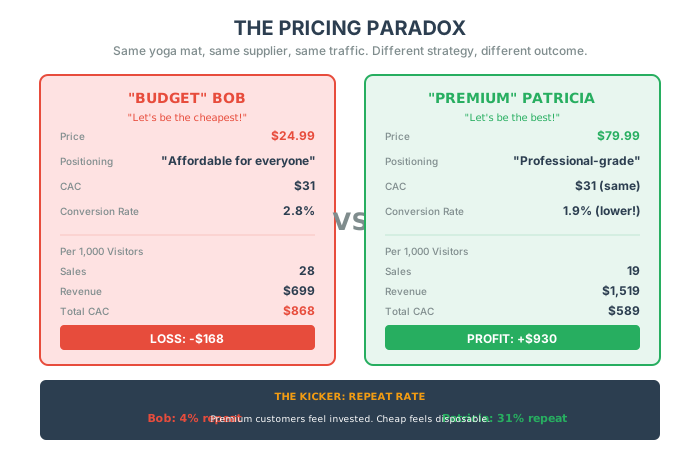
Bob and Patricia both sell the exact same yoga mat. Same supplier. Same product.
Bob’s Strategy: “Let’s be the cheapest!”
- Price: $24.99
- Positioning: “Affordable yoga mat for everyone”
- CAC: $31
- Conversion Rate: 2.8%
Bob loses $6 on every sale and hopes to make it up with repeat purchases. But because his customers see the mat as “cheap,” they don’t come back.
Patricia’s Strategy: “Let’s be the best.”
- Price: $79.99
- Positioning: “The professional-grade mat yogis swear by”
- CAC: $31 (same ads, same traffic)
- Conversion Rate: 1.9%
Patricia’s conversion rate is lower. But let’s do the math:
Bob:
- 1,000 visitors
- 28 sales (2.8% conversion)
- Revenue: $699.72
- CAC: 31)
- Loss: $168.28
Patricia:
- 1,000 visitors
- 19 sales (1.9% conversion)
- Revenue: $1,519.81
- CAC: 31)
- Profit: $930.81
Patricia makes 168. With the same product and same traffic.
Why?
Because premium pricing creates perceived value.
When something costs more, people:
- Believe it’s higher quality
- Take better care of it
- Feel more invested in using it
- Tell their friends about it
- Come back to buy again
Bob’s customers see a 80 mat as an investment.
And here’s the kicker: Patricia’s repeat rate is 31%. Bob’s is 4%.
Patricia’s customers think: “I invested $80 in this mat. I’m going to use it.” And when they love it, they come back for other products.
Bob’s customers think: “Eh, it was $25. Whatever.”
Pro Tip: The “Second Place Curse”
There is no strategic benefit to being the second cheapest in the marketplace. But there is a benefit to being the most expensive.
Premium pricing is a moat. Discount pricing is a race to the bottom.
The Discount Death Trap
Section titled “The Discount Death Trap”
Let me tell you about “Discount Dan.”
Dan sold premium coffee. Or at least, he thought it was premium.
Dan’s Promotion Calendar:
- Week 1: “10% off for new customers”
- Week 2: “Free shipping on orders over $30”
- Week 3: “BOGO 50% off”
- Week 4: “20% off everything—our biggest sale!”
Then repeat.
What happened:
Month 1:
- Sales during promo weeks: $42,000
- Sales during non-promo weeks: $8,000
- Dan thought: “Promotions work! Let’s do more!”
Month 6:
- Sales during promo weeks: $39,000 (declining)
- Sales during non-promo weeks: $1,200 (collapsing)
- Dan thought: “We need bigger discounts!”
Month 12:
- Dan ran a “40% off everything” sale
- Revenue: $51,000
- Margin after discount and CAC: -$4,200
- Dan closed the business
What went wrong?
Dan trained his customers to only buy on discount.
They’d sign up for the email list. Wait for the promo. Buy. Then wait for the next one.
Nobody paid full price. Because why would they?
The Discount Death Spiral:
- You run a promotion to boost sales
- Sales spike during the promotion
- Sales crash after the promotion
- You panic and run another promotion
- Customers wait for promotions
- Your margins erode
- You can’t afford to acquire new customers at full price
- You become addicted to discounts
- Your brand becomes “the discount brand”
- You lose
The Fix:
Instead of discounting, add value.
Bad: “20% off”
Good:
- “Free gift with purchase” (costs you 20)
- “Exclusive access to new products”
- “Free upgrade to premium shipping”
- “Bundle and save” (you’re not discounting, you’re bundling)
Real Example:
A jewelry brand I worked with was running 30% off sales every month.
We killed the discounts. Instead:
- “Buy 2, get a free jewelry box” (cost: 35)
- “VIP Early Access” for email subscribers (free, but feels exclusive)
- “Limited Edition” drops (no discount, higher price, sold out in 48 hours)
Revenue stayed the same. But margins increased by 28%.
And customers started paying full price again.
The Strategic Priorities Framework
Section titled “The Strategic Priorities Framework”Here’s the truth: you can’t optimize everything at once.
You have limited time, limited resources, limited attention.
So you have to prioritize.
If your LTV is less than 3x your CAC: → Stop spending on acquisition. Fix your retention first.
If your repeat purchase rate is below 20%: → Focus on post-purchase experience and email marketing.
If your AOV is below $60: → Add bundles, upsells, and free shipping thresholds.
If your conversion rate is below 2%: → Fix your product pages, checkout flow, and trust signals.
Priority Order:
- Fix unit economics (LTV must be > 3x CAC)
- Increase AOV (bundles, upsells)
- Improve retention (email, loyalty, subscriptions)
- Scale acquisition (only after 1-3 are solid)
Most brands do this backward. They scale acquisition with broken unit economics and wonder why they’re losing money.
The Bottom Line
Section titled “The Bottom Line”Your core strategy isn’t about tactics. It’s about economics.
And the economics are simple:
CAC < LTV / 3
If that’s not true, you don’t have a business. You have an expensive hobby.
Three things to do this week:
- Calculate your true CAC – Include everything. Not just ad spend.
- Calculate your LTV – AOV × Purchase Frequency × Customer Lifespan
- Check the ratio – If LTV:CAC is less than 3:1, stop scaling and fix retention.
The goal isn’t to get more customers. The goal is to build a machine that prints money.
And that machine runs on unit economics.
In the next chapter, we’re diving into funnel optimization—why your checkout flow is costing you millions, and the 3-click rule nobody talks about.