

AI & Voice
Leveraging new technologies for competitive advantage
“The best interface is no interface.”
Golden Krishna
10 years ago, we clicked mice. 5 years ago, we tapped glass. Tomorrow, we speak.
You run out of toothpaste. You do not open your laptop. You do not unlock your phone. You shout at the cylinder in your kitchen: “Alexa, buy me more toothpaste.”
If your brand is not on Alexa’s shortlist, you do not exist. You are invisible. This is not a “Sales Channel.” This is an existential threat.
The $19 Billion Opportunity
Section titled “The $19 Billion Opportunity”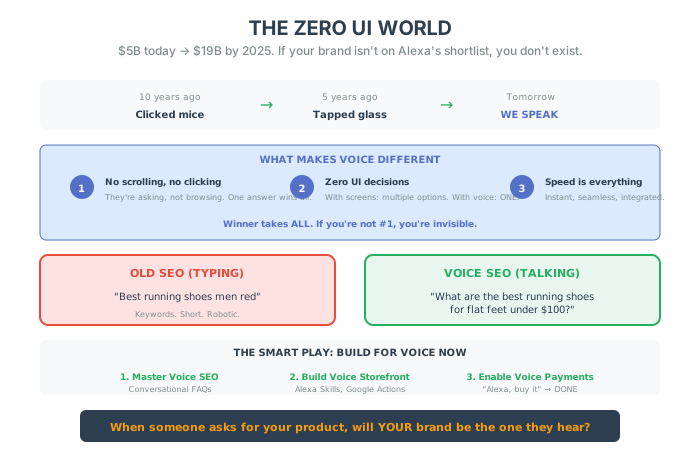
Right now, voice commerce is a 19 billion**.
But if you ask most brands what their voice strategy is, they don’t have one.
Consumers are already talking to Alexa, Siri, and Google Assistant for everyday tasks—ordering groceries, booking rides, playing music. The behavioral shift has happened.
But businesses? They’re lagging behind.
This is your window. The brands that move now will dominate this $19 billion wave before the rest of the market catches up.
The “Zero UI” World
Section titled “The “Zero UI” World”We are moving to a world with Zero UI (User Interface). There are no menus. There are no “Related Products” widgets. There is just the answer. The winner takes all.
What makes voice commerce different:
- No scrolling, no clicking. Consumers aren’t browsing—they’re asking. If your brand isn’t optimized for voice search, you’re invisible.
- Zero UI decisions. With screens, consumers see multiple options. With voice, they get one answer—whoever ranks first wins.
- Speed over everything. A customer won’t wait for a slow checkout. The experience has to be instant, seamless, and integrated.
This changes how businesses need to think about sales, discovery, and brand presence.
The Strategy: You must stop optimizing for “Keywords” (Typing). You must start optimizing for “Natural Language” (Talking).
- Old SEO: “Best running shoes men red.”
- Voice SEO: “What are the best running shoes for flat feet that are under $100?”
The Mistakes Businesses Are Making
Section titled “The Mistakes Businesses Are Making”Most brands assume voice commerce is just another sales channel. It’s not. It’s a different behavioral channel.
Mistake #1: Ignoring Voice SEO If your brand isn’t optimized for voice search, Alexa and Google Assistant won’t surface you. You’re invisible to the fastest-growing search modality.
Mistake #2: Treating It Like a Website Voice is conversational. Consumers aren’t “browsing” menus—they’re asking direct questions. Your content needs to answer questions, not list features.
Mistake #3: Forgetting Frictionless Purchasing Without seamless voice-enabled transactions, you lose conversions before they even start. If they can search by voice but have to type to pay, you’ve lost.
The Smart Play: Build for Voice Now
Section titled “The Smart Play: Build for Voice Now”Brands that win in voice commerce will take these three steps:
1. Master Voice SEO
Section titled “1. Master Voice SEO”Optimize for natural language queries, not just keywords. Someone typing “best running shoes” will say, “Alexa, what are the best running shoes for flat feet?”
Action: Rewrite your FAQ page. Don’t write corporate policy. Write conversational answers. If I ask your site a question, it should sound like a human answering.
Focus on:
- Question-based content (“What is…”, “How do I…”, “Where can I…”)
- Long-tail conversational phrases
- Local queries (“near me”, “in [city]”)
- Comparison queries (“vs”, “better than”)
2. Create a Voice Shopping Experience
Section titled “2. Create a Voice Shopping Experience”Develop Alexa Skills and Google Actions to create a conversational buying flow. Think of it as your voice storefront—if you don’t build it, someone else will own that interaction.
Building Your Voice Presence:
- Create an Alexa Skill that lets customers browse and buy your products
- Build Google Actions for product search and reordering
- Design conversational flows that feel natural, not robotic
- Test with real users to eliminate friction points
3. Integrate Voice Payments
Section titled “3. Integrate Voice Payments”Friction is the enemy of revenue. Voice is the ultimate friction remover. But most stores fail at the finish line. They let you search by voice, but they make you type to pay.
That is like running a marathon and crawling the last 10 feet.
Enable Voice Payments. Amazon Pay. Google Pay. Apple Pay. Close the loop. “Alexa, buy it.” -> Done.
The fewer steps, the higher the conversion.
The AI Trust Crisis
Section titled “The AI Trust Crisis”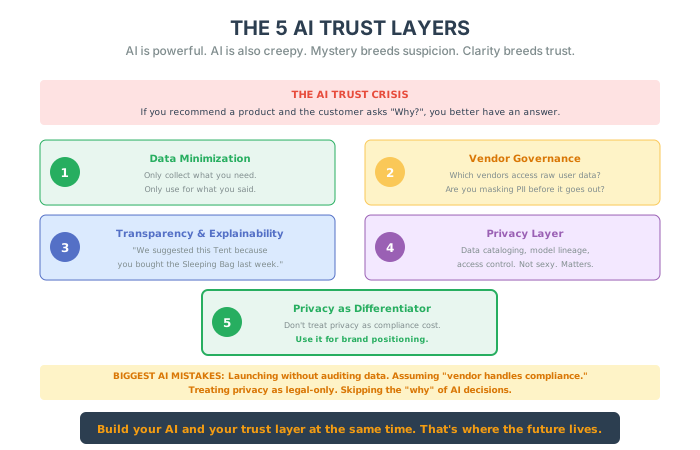
Everyone wants AI on their site. Chatbots. Recommendation engines. Guided search. Personalization.
But here’s what nobody asks: Where’s the trust layer?
AI is powerful. It is also creepy. People do not trust “Black Box” algorithms that track their every move. If you recommend a product and the customer asks “Why?”, you better have an answer.
The common belief I think is outdated: Most people assume: “If we build a smart AI engine, it’ll automatically win us conversions, happy customers, and market share.”
That’s not enough anymore. The weak link isn’t the AI model—it’s the trust infrastructure around it.
When a brand says “we want AI,” they’re often focused on the shiny bit—“recommend more, chat faster, personalize deeper.”
What they’re not asking (yet) is:
- Are we tracking user data in a way that’s transparent and documented?
- Do we know exactly what data we’re feeding the model—and is it appropriately anonymized?
- How are we controlling third-party access to that AI data layer?
- What happens if the model misfires or behaves in a way that feels creepy?
Those are the “trust layer” questions. And they matter at least as much as the “build faster” questions.
The 5 Trust Layers You Need
Section titled “The 5 Trust Layers You Need”1. Data Purpose-Limitation & Minimization Only collect data you need. Only use it for what you told users you’d use it for.
If you said “we’ll personalize recommendations,” don’t secretly use that same data for aggressive upsells unless you’ve disclosed it, obtained consent, and logged the vendor/processing chain.
2. Third-Party and Vendor Governance Every plugin is a potential weak link—analytics, chatbots, personalization engines, image recognition.
Ask yourself:
- Which vendors access raw user data?
- Does the model vendor retain or store data?
- Are we masking or redacting PII before it goes out?
The model might be excellent, but if the pipeline isn’t governed, you’re exposed.
3. Transparency & Explainability Even if your model works great, users balk if it “feels” like you’re stalking them.
The Fix: Transparent AI. Don’t just show the recommendation. Explain it. “We suggested this Tent because you bought the Sleeping Bag last week.”
Build into your UX: “Why did we recommend this? You viewed X and added Y to cart. Review your settings here.”
The Rule: Mystery breeds suspicion. Clarity breeds trust. If they trust the algorithm, they will buy what it says.
4. Build a Privacy Layer Around the AI This includes:
- Data cataloging (what fields, what purpose)
- Model-data lineage (which data trained which model)
- Access control (who sees raw vs. aggregated data)
It’s not sexy. But it matters.
5. Use Privacy as a Differentiator Don’t treat privacy as a compliance cost. Use it for brand positioning.
Frame it like: “Yes, you want AI for conversion uplift—but you also want to avoid reputational hits. Doing both now positions you ahead.”
The Biggest AI Mistakes I See
Section titled “The Biggest AI Mistakes I See”Mistake #1: Launching personalization AI without auditing the raw data The data feeding the model might have undocumented third-party sources or unmasked PII. If the model “learns” on that, you might unwittingly expose something.
Mistake #2: Thinking “our vendor handles compliance” without verifying Just because an AI provider says “we comply with GDPR” doesn’t mean your site’s integration, consent banner, and vendor network are all aligned. Ask for vendor-data maps, retention policies, and zero-data-retention guarantees.
Mistake #3: Treating privacy as legal stuff only, not UX/trust/brand If a user feels uneasy (“hey, why are you recommending that?”), that friction kills conversions. Weave in UX messaging: “Your data, your control. Our model, your experience.”
Mistake #4: Skipping the “why” of AI decisions for users If the AI brings a weird recommendation, the user may dismiss it as creepy. Build a minimal explainability layer: “This appears because you viewed X and added Y to cart.”
Using AI for Content Creation
Section titled “Using AI for Content Creation”In my 10+ years in ecommerce, I’ve learned that standing out is both an art and a science. Blending human creativity with AI’s precision can spark magic.
Craft Your Unique Brand Voice
Section titled “Craft Your Unique Brand Voice”To use AI effectively, first picture your brand as a person with a distinct personality.
Are you outdoorsy and adventurous or sophisticated and sleek? Identify 3-5 adjectives that embody your essence.
Fill in this sentence: “I want people to recognize my brand as _______.”
Identify Your Content Type and Platform
Section titled “Identify Your Content Type and Platform”Determine the content type you want to create and the designated platform.
Are you writing an article for a blog? A product description? A social media post?
Since each platform addresses content uniquely, identify where it’s going. Tweet? LinkedIn post? Website?
Fill in: “I want to create a _______ on _______ platform.”
Leverage Data to Guide Your Strategy
Section titled “Leverage Data to Guide Your Strategy”AI excels at detecting patterns in data, but it lacks human context. Combine its computational capacities with your insights about customer motivations.
- Analyze search trends via tools like Google’s Keyword Planner to identify high-opportunity keywords
- Review support tickets and product reviews to uncover pain points to address
Fill in: “This content should cater to my target audience, which is _______.”
Optimize for Scannability
Section titled “Optimize for Scannability”Chunk your content into scannable sections tailored to digital reading habits.
- Use clear headers and subheaders so readers can quickly navigate
- Highlight 3-5 main takeaways upfront through bullet points
- Break sections into 300-500 words for quicker consumption
Check Quality Before Publication
Section titled “Check Quality Before Publication”Like any marketing asset, properly vet AI-generated content before publishing.
- Have an editor review for typos, formatting issues, and factual inaccuracies
- Compare against brand guidelines to guarantee appropriate voice and tone
- Run plagiarism checks to verify originality
Craft Compelling Stories
Section titled “Craft Compelling Stories”Storytelling helps brands make emotional connections. Use AI to craft authentic stories that resonate.
- Share the origin story of your business or products on your homepage
- Convey a day-in-the-life featuring your products through a customer’s eyes
- Turn positive reviews into shareworthy testimonials
Example AI Prompt: “Please write a product description for our high-performance running shoe on our website. The messaging should cater to our target audience: young athletes ages 18-25 looking for a competitive edge. Write in a conversational yet professional tone. The content should capture our brand voice: motivating, inspirational, and dependable. Optimize for SEO using terms like ‘athletic shoes,’ ‘high performance footwear,’ and ‘best shoes for running.’ Highlight light materials, durability, and features like soft cushioning, air vents, and sleek design. Use real-life scenarios to illustrate effectiveness, and conclude with a call to action.”
The Content Audit
Section titled “The Content Audit”Go to your website. Open your Top 10 Product Pages. Read the description out loud. Do you stumble? Do you sound like a robot? Do you sound like a lawyer?
If it is hard to say, it is hard to sell. Rewrite it for the ear, not the eye. In a voice-first world, your copy isn’t read. It is spoken.
The Bottom Line
Section titled “The Bottom Line”The future of e-commerce isn’t just visual—it’s vocal. And the brands that move now will dominate.
The Voice & AI Equation:
- Natural language > Keywords
- Conversational content > Corporate copy
- Trust layers > Raw AI
- Transparency > Black boxes
- Frictionless payments > Multi-step checkout
Five things to do this week:
- The “Siri Test”: Pick up your phone. Ask Siri: “Where can I buy [Your Product Category]?” If your brand doesn’t come up, you have work to do. Start by optimizing your “Near Me” local SEO.
- Rewrite Your FAQ: Go to your FAQ page. Read the first question out loud. Does it sound like a human answering? if not, rewrite it. Voice search looks for conversational answers, not corporate jargon.
- Audit Your “Creep Factor”: Look at your product recommendations. Do you explain why something is recommended? Add a label: “Because you viewed X.” Transparency builds trust.
- Enable Wallets: If you don’t have Apple Pay and Google Pay enabled, do it today. Voice shoppers do not want to get up and find their credit card.
- The “No-UI” Audit: Close your eyes. Have someone read your homepage to you. Does it make sense? If your value proposition relies entirely on visuals, you will lose in the voice era.
So the real question is:
When someone asks their smart speaker for the product you sell…
Will your brand be the one they hear?
Build your AI and your trust layer at the same time. That’s where the future lives.
In the next chapter, we are going to look at the macro view: Trends & Analysis. How to spot the next wave before it hits you.