

Psychology & Persuasion
The core psychological principles—scarcity, urgency, sensory language, and emotional triggers—that influence buying behavior
“People don’t buy what you do; they buy why you do it.”
Simon Sinek
Imagine walking into a grocery store.
You grab a cart. You walk down the aisles. You pick up milk, eggs, a steak, and a pack of Oreos (don’t lie, you do). You have $100 worth of groceries in your cart.
You walk up to the checkout lane. You put everything on the belt. The cashier scans it all.
And then… you just walk out.
You leave the food. You leave the store. You get in your car and drive away.
Sound crazy?
7 out of 10 people do this on your website every single day.
The stats are brutal: The average cart abandonment rate is 69.57%.
That means for every 7 before it hits the register.
Why?
It’s not usually the price. It’s not usually the product. It’s the Psychology.
The Psychology Detection Protocol
Section titled “The Psychology Detection Protocol”Before you can fix your persuasion problems, you need to find them. Here’s a 30-minute audit that reveals where psychology is working against you.
Step 1: The Trust Betrayal Audit
Section titled “Step 1: The Trust Betrayal Audit”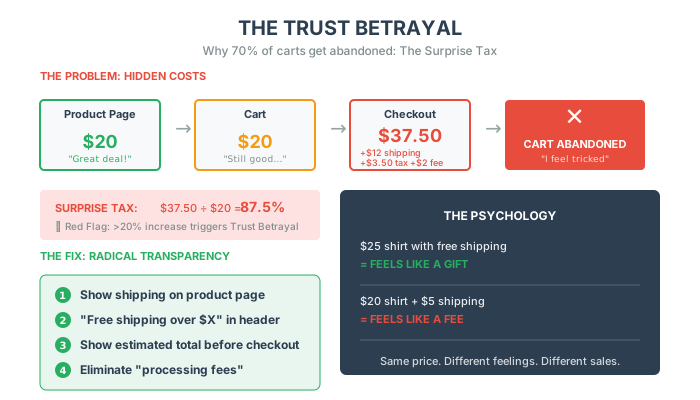
Track the price journey from product page to checkout:
| Stage | Price Shown | What Gets Added | 🚨 Red Flag If |
|---|---|---|---|
| Product page | $___ | N/A | Price not visible |
| Cart | $___ | +$___ | New fees appear |
| Checkout Step 1 | $___ | +$___ | Shipping not shown |
| Checkout Step 2 | $___ | +$___ | Taxes added late |
| Final Total | $___ | Total Added: $___ | > 20% increase from product |
Calculate your “Surprise Tax”:
- Final Total ÷ Product Page Price = ___
- 🚨 Red Flag: If > 1.20 (20% increase), you’re triggering Trust Betrayal
Step 2: The Persuasion Element Audit
Section titled “Step 2: The Persuasion Element Audit”Check your product pages for these conversion triggers:
| Persuasion Element | Present? | Quality (1-5) | 🚨 Red Flag If |
|---|---|---|---|
| Scarcity indicator | Yes / No | ___ | Missing on top sellers |
| Urgency element | Yes / No | ___ | No time-based trigger |
| Social proof (reviews) | Yes / No | ___ | < 10 reviews shown |
| Real-time activity | Yes / No | ___ | No “X people viewing” |
| Authority signals | Yes / No | ___ | No credentials/certifications |
| Trust badges | Yes / No | ___ | Below the fold |
Your Persuasion Score: Count the “Yes” answers
- 0-2: 🚨 Critical (likely losing 30%+ of potential sales)
- 3-4: Needs work
- 5-6: Good foundation
Step 3: The Friction Point Audit
Section titled “Step 3: The Friction Point Audit”Navigate your own checkout and count decisions:
| Friction Element | Count | 🚨 Red Flag If |
|---|---|---|
| Form fields required | ___ | > 8 fields |
| Pages to complete checkout | ___ | > 2 pages |
| Account creation required? | Yes / No | Yes (before purchase) |
| Upsells before payment | ___ | > 2 offers |
| Payment options shown | ___ | < 3 options |
| Guest checkout available? | Yes / No | No |
Your Friction Score: Total form fields × pages × upsells = ___
- 🚨 Red Flag: If score > 24, you’re bleeding conversions
Step 4: The Emotional Connection Audit
Section titled “Step 4: The Emotional Connection Audit”| Element | Present? | 🚨 Red Flag If |
|---|---|---|
| Origin story on About page | Yes / No | Missing or corporate-speak |
| Founder visible in brand | Yes / No | No human face anywhere |
| Customer stories (not just reviews) | Yes / No | Only star ratings |
| Community/engagement program | Yes / No | Only transactional loyalty |
| Sensory language in descriptions | Yes / No | Just specs and features |
Your Connection Score: Count “Yes” answers
- 0-1: 🚨 You’re a vending machine, not a brand
- 2-3: Functional but forgettable
- 4-5: Building real relationships
The 3-Tier Psychology Fix Framework
Section titled “The 3-Tier Psychology Fix Framework”Quick Fixes (This Week: 2-8 hours, immediate impact)
Section titled “Quick Fixes (This Week: 2-8 hours, immediate impact)”1. Eliminate the Surprise Tax
Show all costs as early as possible:
- Add shipping estimate to product page (based on IP geolocation)
- Show “Free shipping at $X” in header
- Display tax estimate before checkout
Time: 2-3 hours Impact: Reduces cart abandonment by 10-15%
2. Add Scarcity/Urgency Signals
For every product page:
- Real-time inventory count (“Only 4 left”)
- Shipping deadline (“Order in 2h 47m for same-day shipping”)
- Recent purchase activity (“12 bought in last 24 hours”)
Time: 2-4 hours Impact: Increases conversion 5-15% on affected products
3. Trust Badge Placement
Move trust signals above the fold on product pages:
- Payment security badges
- Money-back guarantee
- Star rating aggregate
- “Ships from [Country]” indicator
Time: 1-2 hours Impact: Reduces purchase anxiety immediately
Medium Fixes (This Month: 1-3 weeks, systematic improvement)
Section titled “Medium Fixes (This Month: 1-3 weeks, systematic improvement)”1. Checkout Friction Reduction
Audit and eliminate:
- Remove “Company Name” field (unless B2B)
- Make phone number optional
- Implement address autocomplete
- Enable one-click payment (Apple Pay, Google Pay, Shop Pay)
- Move account creation to post-purchase
Time: 1 week Impact: 10-25% improvement in checkout completion
2. Social Proof Enhancement
Build comprehensive proof elements:
- Photo reviews with incentives
- Video testimonials from real customers
- Real-time purchase notifications
- “As seen in” media logos
- Expert endorsements or certifications
Time: 2-3 weeks Impact: Increases trust and conversion across all pages
3. Product Description Rewrites
Transform spec sheets into sensory experiences:
- Apply 5 Senses Framework to top 20 products
- Add “lifestyle” benefits, not just features
- Include customer language from reviews
- A/B test new copy against old
Time: 1-2 weeks Impact: 5-20% improvement in product page conversion
Deep Fixes (This Quarter: 4-8 weeks, competitive advantage)
Section titled “Deep Fixes (This Quarter: 4-8 weeks, competitive advantage)”1. Full Persuasion Architecture
Build a systematic persuasion system:
- Map customer journey with persuasion touchpoints
- Implement reciprocity sequence (free value before ask)
- Create commitment ladder (micro-yeses before purchase)
- Design authority content strategy
Time: 4-6 weeks Impact: Transforms one-time visitors into loyal customers
2. Brand Story Development
Create authentic emotional connection:
- Document and publish origin story
- Feature founder/team prominently
- Develop “behind the scenes” content program
- Create customer transformation stories (not just reviews)
Time: 2-4 weeks Impact: Increases brand preference and willingness to pay premium
3. Community Building
Move beyond transactions:
- Launch engagement-based loyalty program
- Create customer community space
- Develop user-generated content program
- Implement customer advisory board
Time: 6-8 weeks Impact: Reduces CAC through organic evangelism, increases LTV
The “Trust Betrayal” (The Hidden Cost Trap)
Section titled “The “Trust Betrayal” (The Hidden Cost Trap)”The number one reason people abandon carts is not “Price.” It’s Surprise.
Imagine you see a shirt for $20. You think, “Great deal.” You click “Add to Cart.” You click “Checkout.” You type in your address. Then, suddenly:
- Shipping: $12.00
- Taxes: $3.50
- Handling Fee: 37.50**.
You didn’t just increase the price. You lied.
In psychology, this triggers a Trust Betrayal. The user feels tricked. Their cortisol (stress hormone) spikes. Their “Flight” response activates. And they click the “X” button.
The Fix: Radical Transparency. Do not hide your costs.
- “Free Shipping on Orders over $50.” (Incentive).
- “Flat Rate $5 Shipping.” (Certainty).
If you are going to charge them, tell them before they fall in love with the shirt. A 20 shirt with $5 shipping. Why? Because the first one feels like a gift, and the second one feels like a fee.
But here’s the thing most brands get wrong: Radical Transparency isn’t just about shipping costs. It’s a philosophy.
[Radical Transparency]: The practice of being upfront about everything—your costs, your margins, your supply chain, even your mistakes.
Look at Everlane. They literally show customers the cost breakdown of every product. Materials: 8. Shipping: 16. Total: $40.
Most brands would never do this. They’d say, “But if they know our margin, they’ll think we’re ripping them off!”
Wrong.
Here’s what actually happens: 70% of consumers are willing to pay more for a brand they trust. The transparency doesn’t cost you sales. It creates loyalty.
Here’s how to weaponize transparency:
-
Share Your Costs: Break down what goes into your products. Explain why the pricing is what it is. Customers aren’t stupid—they know there’s a markup. They just want to know it’s fair.
-
Own Your Mistakes: Something shipped late? Don’t hide behind a vague “delays may occur” email. Say: “We screwed up. Your order should have shipped Tuesday. It shipped Thursday. Here’s 15% off your next order, and here’s exactly what we’re doing to make sure it doesn’t happen again.”
-
Show Behind-the-Scenes: Use social media to show the humans behind the brand. The warehouse team. The customer service reps. The founder at 2am packing boxes. Customers love seeing that they’re buying from people, not a faceless corporation.
Pro Tip: The “Pay What You Want” Experiment
Consider running a limited “pay what you want” pricing model on a new product. Sounds insane, right? Here’s the thing: it generates massive buzz, builds deep trust with your audience, and the data you collect on perceived value is priceless for future pricing decisions. Most people pay more than you’d expect.
The Race to the Bottom vs. The Brand Moat
Section titled “The Race to the Bottom vs. The Brand Moat”“But Alex, my competitors are cheaper!”
Who cares?
If you compete on price, you are entering a Race to the Bottom. And the problem with a race to the bottom is that you might win. And then you are the cheapest, brokest guy in the room.
To escape the price war, you need a Moat. You need a Brand Story.
[Brand Story]: The narrative that makes your product a part of the customer’s Identity.
People don’t buy TOMS shoes because they are the best canvas shoes. They buy them because they want to be the “Kind person who helps kids.” People don’t buy Patagonia because it’s warmer. They buy it to be the “Eco-conscious adventurer.”
The Formula is simple: Value = Product + Story. Commodity = Product - Story.
If you are a commodity, you have to be cheap. If you have a story, you can be expensive. And they will thank you for it.
The Persuasion Stack (Ethical Brain Hacking)
Section titled “The Persuasion Stack (Ethical Brain Hacking)”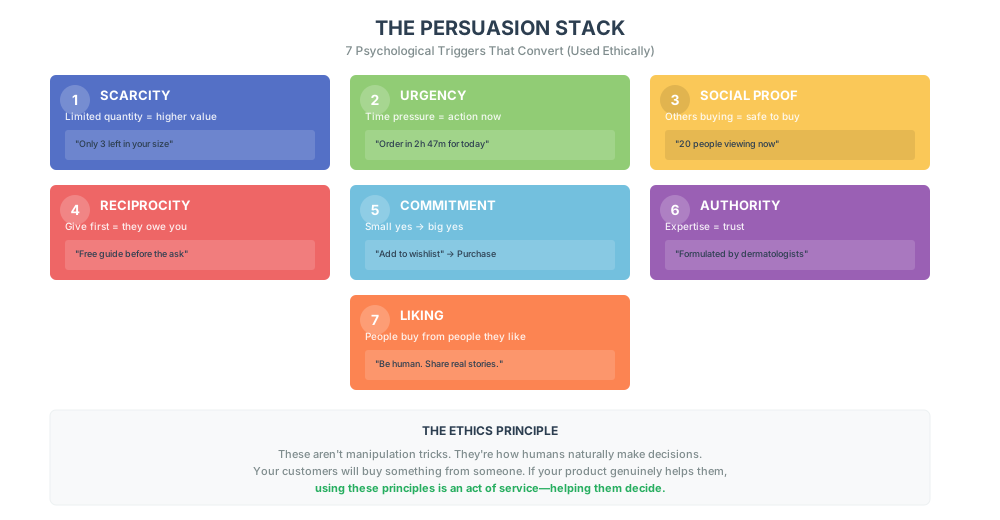
Once you have fixed the Trust Betrayal and built the Story, you need to gently push them over the line. You need to use their biology against them (in a good way).
Let me break this down. There are six psychological triggers that have been studied for decades. They work. Every. Single. Time. When used ethically, they don’t manipulate—they help customers make decisions they already want to make.
1. Scarcity (The “Empty Shelf” Effect)
Section titled “1. Scarcity (The “Empty Shelf” Effect)”If there are 1,000 units in stock, I can buy it tomorrow. If there are 3 units in stock, I have to buy it NOW. Tactic: “Only 3 left in your size.” (It must be true. Don’t lie).
Here’s the psychology: When something is scarce, our brains assign it more value. It’s called the Scarcity Heuristic. We evolved this way—when food was scarce on the savanna, you grabbed it or you starved. Your customers’ brains still work the same way.
Types of scarcity you can use:
- Total Supply Cap: “We only made 500 of these. When they’re gone, they’re gone.”
- Growth Rate Cap: “We only accept 10 new customers per week.”
- Personal Scarcity: “Only 2 left in your size.”
2. Urgency (The Clock)
Section titled “2. Urgency (The Clock)”Time minimizes procrastination. Tactic: “Order in the next 10 minutes for ships-today status.” You are giving them a logical reason to act now instead of later.
The difference between Scarcity and Urgency: Scarcity is about quantity. Urgency is about time. Both trigger the fear of loss, but they work on different parts of the brain.
Types of urgency:
- Countdown Timers: “Sale ends in 2:47:33”
- Deadline-based: “Order by 3pm for same-day shipping”
- Cohort-based: “Next class starts Monday. Miss it, wait 30 days.”
Pro Tip: The “Rolling Seasonal” Strategy
Instead of running one big sale a year, create rolling urgency throughout the year. New Year Promo ends January 30th. Valentine’s Promo starts February 1st. Spring Clean-out starts March 1st. There’s always a reason to buy now—but it’s always genuine, not fake.
3. Social Proof (The Crowd)
Section titled “3. Social Proof (The Crowd)”We are herd animals. If everyone looks up, we look up. Tactic: “20 people are viewing this item right now.” It signals: “This is valuable. Do not lose it to the herd.”
But social proof goes deeper than view counts. Here are the types:
- Testimonials & Reviews: The classics. But don’t just show star ratings—show stories. “I was skeptical, but after 3 weeks my back pain is completely gone.”
- Real-time Activity: “Sarah from Austin just purchased this.”
- Media Mentions: “As featured in Forbes, WSJ, TechCrunch.”
- Celebrity/Expert Endorsement: “Recommended by Dr. [Name].”
- Numbers: “Join 47,382 happy customers.”
4. Reciprocity (The Gift)
Section titled “4. Reciprocity (The Gift)”Here’s one most e-commerce brands completely miss.
[Reciprocity]: When someone does something for us, we naturally want to return the favor.
You’ve felt this. Someone buys you a coffee, and suddenly you feel weird until you buy them one back. It’s hardwired.
How to use it:
- Free Value First: Give away genuinely useful content—guides, tools, calculators—before asking for the sale.
- Surprise Gifts: Throw in a small unexpected bonus with their order. A handwritten note. A sample of another product. It costs you $2 and creates a customer for life.
- First-time Discounts: “Here’s 15% off your first order, just for signing up.” They feel they owe you a purchase.
The key: Give before you ask. Always.
5. Commitment & Consistency (The Small Yes)
Section titled “5. Commitment & Consistency (The Small Yes)”People like to be consistent with their past actions. If they said “yes” once, they want to say “yes” again.
This is why smart brands don’t ask for the sale first. They ask for micro-commitments:
- “Create a free account” (small yes)
- “Add to wishlist” (small yes)
- “Take our style quiz” (small yes)
- “Sign up for restock notifications” (small yes)
Each small yes makes the big yes (the purchase) feel like the natural next step.
Tactic: The Subscription Nudge Once someone buys once, offer them a subscription. Not because you’re greedy—because they’ve already proven they like the product. Subscribing is just being consistent with their past behavior. Make it easy for them to do what they already want to do.
6. Authority (The Expert)
Section titled “6. Authority (The Expert)”People respect expertise. They follow the lead of credible, knowledgeable authorities.
In e-commerce, authority looks like:
- Credentials: “Formulated by dermatologists.” “Designed by NASA engineers.”
- Experience: “We’ve shipped 2 million orders since 2015.”
- Certifications: “Certified organic.” “FDA approved.” “B-Corp certified.”
- Expert Partnerships: Collaborate with influencers who have real credibility (not just followers).
When customers see you as an authority, they trust your recommendations. And trust converts.
7. Liking (The Friend)
Section titled “7. Liking (The Friend)”Simple truth: We buy from people we like.
How do you become likable as a brand?
- Be Human: Don’t hide behind corporate-speak. Have a real voice. Share real stories.
- Find Common Ground: Align with your customers’ values and interests. If they care about sustainability, show them you do too—genuinely.
- Engage: Respond to comments. Answer questions. Make customers feel heard.
- Be Attractive: Not just visually (though that matters)—be attractive in your values. Stand for something.
Author Note:
These seven principles aren’t manipulation. They’re how humans make decisions. Your customers are going to buy something from someone. If you believe your product genuinely helps them, using these principles is an act of service—you’re helping them make a decision that benefits them.
The Sensory Shortcut (Words That Sell)
Section titled “The Sensory Shortcut (Words That Sell)”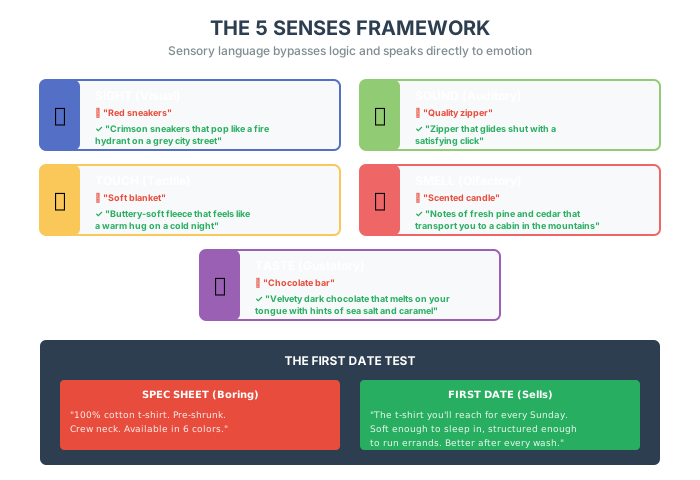
Here’s something most e-commerce brands completely miss: Your brain processes sensory language differently than regular language.
When I say “Blue shirt,” your logical brain activates. You think, “Okay, it’s blue.”
When I say “A deep ocean-blue shirt that feels like wearing a cloud,” something else happens. Your sensory cortex lights up. You feel the fabric. You see the color. You’re no longer reading—you’re experiencing.
[Sensory Language]: Words that invoke the five senses—sight, sound, smell, taste, and touch—to create an immersive mental experience.
Why does this work?
We live in an oversaturated world. Everyone is screaming for attention. Generic product descriptions blur together. But sensory language cuts through the noise because it bypasses the logical brain and speaks directly to emotion.
And emotion is what makes people click “Buy Now.”
The 5 Senses Framework
Section titled “The 5 Senses Framework”1. Sight (Visual)
- Bad: “Red sneakers”
- Good: “Crimson sneakers that pop like a fire hydrant on a grey city street”
2. Sound (Auditory)
- Bad: “Quality zipper”
- Good: “Zipper that glides shut with a satisfying click”
3. Touch (Tactile)
- Bad: “Soft blanket”
- Good: “Buttery-soft fleece that feels like a warm hug on a cold night”
4. Smell (Olfactory)
- Bad: “Scented candle”
- Good: “Notes of fresh pine and cedar that transport you to a cabin in the mountains”
5. Taste (Gustatory)
- Bad: “Chocolate bar”
- Good: “Velvety dark chocolate that melts on your tongue with hints of sea salt and caramel”
The “First Date” Test
Section titled “The “First Date” Test”Read your product description out loud.
Does it sound like a spec sheet? Or does it sound like you’re describing something to a friend who can’t see it?
Spec Sheet (Boring):
“100% cotton t-shirt. Pre-shrunk. Crew neck. Available in 6 colors.”
First Date (Sells):
“This is the t-shirt you’ll reach for every Sunday morning. Soft enough to sleep in, structured enough to run errands. The kind of shirt that looks better after every wash.”
The second version doesn’t give you more information. It gives you more feeling.
And feelings convert.
Pro Tip: The “Close Your Eyes” Exercise
Before you publish a product description, close your eyes and have someone read it to you. Can you see the product? Can you feel it? If not, rewrite it until you can. If a blind person couldn’t visualize your product from your words, you haven’t done your job.
The Choice Paradox (Why More Options Kill Sales)
Section titled “The Choice Paradox (Why More Options Kill Sales)”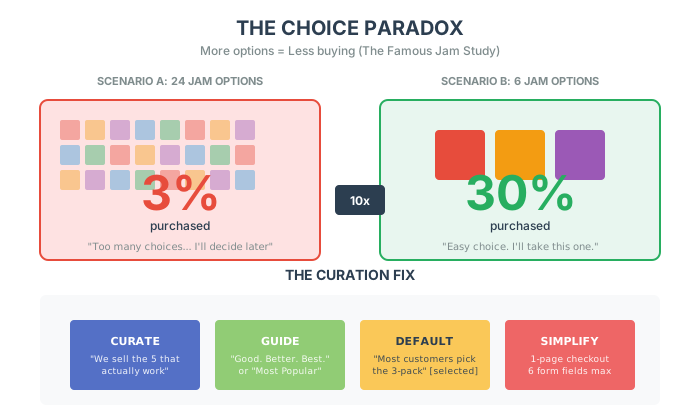
Here’s something counterintuitive: The more choices you give customers, the less they buy.
It’s called the Paradox of Choice, and it’s been proven in dozens of studies. The most famous? The jam study. Researchers set up a table with 24 jams. Tons of people stopped to look. Barely anyone bought. Then they set up a table with 6 jams. Fewer people stopped—but 10x more people purchased.
Why? Decision Fatigue.
[Decision Fatigue]: The deterioration of decision-making quality after making many decisions. The more choices someone has to make, the more likely they are to make no choice at all.
Your customers arrive at your site already exhausted. They’ve made hundreds of decisions today. What to wear. What to eat. How to respond to that email. Whether to take that call.
And then you hit them with:
- 47 product variations
- 12 color options
- 3 shipping methods
- 5 payment options
- 4 upsells
- 2 cross-sells
- A popup asking for their email
Their brain screams: This is too hard. I’ll do it later.
“Later” means “never.”
The Curation Fix
Section titled “The Curation Fix”Here’s the counterintuitive move: Limit your product selection.
Conventional wisdom says more products = more chances for a sale. Reality says more products = more confusion = more abandonment.
How to apply this:
-
Conduct a Product Audit: Identify your best sellers and most profitable items. Consider phasing out everything else. Yes, phasing out. If a product doesn’t sell, it’s not an asset—it’s a distraction.
-
Curate Aggressively: Position your limited selection as intentional. “We don’t sell 50 different supplements. We sell the 5 that actually work.” Scarcity + Authority = Premium positioning.
-
Guide the Choice: Instead of showing 24 options, show 3. “Good. Better. Best.” Or “Most Popular.” Or “Recommended for You.” Make the decision easy.
-
Smart Defaults: Pre-select the option most customers choose. “Most customers pick the 3-pack” with that option already selected. You’re not removing choice—you’re making the right choice effortless.
The Checkout Friction Killer
Section titled “The Checkout Friction Killer”Decision fatigue doesn’t just kill browsing—it murders checkouts.
55% of customers have walked away from a purchase because they felt overwhelmed by the process. Not the price. The process.
Every field they have to fill out is a decision. Every page they have to click through is friction. Every “Are you sure?” is a chance to bail.
Here’s the fix:
-
Cut Every Non-Essential Field: Do you really need their phone number? Their birthday? Their company name? If it’s not required to ship the product or charge the card, delete it.
-
Smart Autofill: Use address autocomplete. Auto-detect card type from the number. Pre-fill everything you can.
-
Guest Checkout: Forcing account creation before purchase is suicide. Let them buy first. Offer the account after they’ve committed.
-
One-Page Checkout: Every additional page is a cliff where customers fall off. Compress it. Simplify it. Make it frictionless.
-
Kill the Surprise Upsells: Yes, I know you want to increase AOV. But slamming them with 5 upsells after they’ve decided to buy creates new decisions they weren’t prepared to make. Limit cross-sells to 1-2 highly relevant offers with easy “No thanks” dismissal.
Pro Tip: The “Save for Later” Safety Net
Accept that distractions happen. The dog barks. The phone rings. The kids need attention. Instead of losing that customer forever, give them an easy “Save Cart for Later” option. Then send them a reminder email 4 hours later, 24 hours later, and 72 hours later. Include a small incentive in the third email. You’re not being pushy—you’re being helpful. They wanted to buy. Life got in the way. You’re just bringing them back.
The Emotional Connection (Beyond the Transaction)
Section titled “The Emotional Connection (Beyond the Transaction)”Here’s what separates brands that survive from brands that thrive: Emotional connection.
In the rush to optimize conversion rates and average order values, most brands forget something fundamental: Emotions drive purchases. Logic justifies them.
Your customer doesn’t really need another pair of sneakers. They want to feel athletic. They want to feel stylish. They want to feel like the person they imagine themselves to be when they lace up.
Tap into that, and price becomes irrelevant.
Tell Your Origin Story
Section titled “Tell Your Origin Story”Every brand has a story. Most brands hide it.
Don’t.
- What inspired you to start this company?
- What problem were you trying to solve?
- What challenges did you overcome?
- What do you believe that others don’t?
Share it. Authentically. Not in corporate-speak, but in real human language.
Bad: “Our company was founded in 2018 with a mission to provide high-quality products at competitive prices.”
Good: “I started this company in my garage after my daughter was diagnosed with eczema. Every ‘gentle’ lotion we tried made it worse. So I spent 18 months learning chemistry, testing formulas, and driving my wife crazy with weird-smelling experiments. We finally cracked it. Now I want every kid with sensitive skin to have what my daughter has.”
The second version sells. Because it’s real.
Build Community, Not Just Customers
Section titled “Build Community, Not Just Customers”Transactions are one-time. Communities are forever.
- Create spaces where your customers can connect with each other (not just with you).
- Feature customer stories—not just reviews, but full stories of transformation.
- Respond to every comment, every message, every email. Make people feel heard.
- Give your most engaged customers special access, early releases, input on new products.
When customers feel like they’re part of something bigger than a purchase, they become evangelists. They sell for you. And that’s worth more than any ad spend.
Reward Engagement, Not Just Purchases
Section titled “Reward Engagement, Not Just Purchases”Most loyalty programs are broken. “Buy 10, get 1 free.” That’s not loyalty. That’s a punch card.
Real loyalty programs reward engagement:
- Points for reviews
- Points for social shares
- Points for referrals
- Points for user-generated content
- Exclusive content for members
- Early access to sales
- Personal thank-yous to top customers
When customers feel valued for more than their wallet, they stay. And staying is everything.
Case Study: The Psychology Overhaul
Section titled “Case Study: The Psychology Overhaul”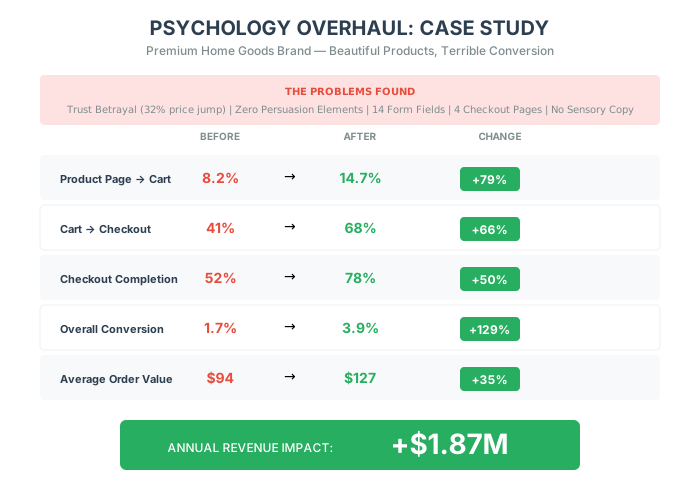
A premium home goods brand reached out with a frustrating problem. Beautiful products. Strong traffic. Terrible conversion.
The Situation
Section titled “The Situation”Their numbers told a painful story:
- Product page to cart: 8.2% (industry average: 12%)
- Cart to checkout: 41% (industry average: 55%)
- Checkout completion: 52% (industry average: 65%)
- Overall conversion: 1.7% (they needed 3%+)
They’d tried everything. New product photos. Faster site speed. Better mobile design. Nothing moved the needle.
“We’ve optimized everything,” the founder told me. “I don’t understand why people won’t buy.”
They’d optimized the technology. They’d ignored the psychology.
The Detection Phase
Section titled “The Detection Phase”We ran the Psychology Detection Protocol:
Trust Betrayal Audit:
- Product page price: $89
- Cart total: $89
- Checkout total: $118 (🚨 32% increase)
- “Surprise Tax”: Shipping (8) + “Processing Fee” ($7) all appeared at final step
- 🚨 Critical: Price jumped by nearly a third at the moment of commitment
Persuasion Element Audit:
- Scarcity indicators: None (🚨)
- Urgency elements: None (🚨)
- Social proof: Only star ratings, no review text (🚨)
- Real-time activity: None (🚨)
- Authority signals: None visible (🚨)
- Trust badges: Footer only (🚨)
- Persuasion Score: 0/6 (🚨 Critical)
Friction Point Audit:
- Form fields: 14 (🚨 Should be < 8)
- Checkout pages: 4 (🚨 Should be 1-2)
- Account creation: Required before purchase (🚨)
- Upsells: 5 different offers during checkout (🚨)
- Payment options: Only credit card (🚨)
- Friction Score: 280 (🚨 Should be < 24)
Emotional Connection Audit:
- Origin story: Generic “About Us” paragraph (🚨)
- Founder presence: None (🚨)
- Customer stories: None (🚨)
- Community program: Points-only loyalty (🚨)
- Sensory language: Just specifications (🚨)
- Connection Score: 0/5 (🚨)
The Problem
Section titled “The Problem”They weren’t selling home goods. They were running an obstacle course.
Every psychological lever was working against them:
- Trust Betrayal: Price shock at checkout
- Zero urgency: “I’ll buy it later” (later = never)
- No social proof: “Why should I trust this brand?”
- Maximum friction: 14 fields, 4 pages, forced account
- No emotional connection: Specs, not stories
Their beautiful products were behind a locked door.
The Intervention
Section titled “The Intervention”Week 1-2 (Quick Fixes):
Eliminated the Surprise Tax:
- Added shipping calculator to product page
- Removed the $7 “processing fee” entirely
- Showed estimated total before checkout
- Result: Price surprise dropped from 32% to 8%
Added Persuasion Elements:
- Real-time inventory (“Only 6 left in stock”)
- Shipping countdown (“Order in 3h 42m for Friday delivery”)
- “47 people viewing this” indicator
- Trust badges moved above Add to Cart button
Week 3-4 (Medium Fixes):
Friction Reduction:
- Cut form fields from 14 to 6
- Compressed 4 checkout pages into 1
- Made account creation post-purchase
- Added Apple Pay, Google Pay, PayPal
- Reduced upsells from 5 to 1 (highly relevant)
Social Proof Enhancement:
- Added photo reviews with incentive program
- Featured full review text, not just stars
- Added “As featured in” logos (3 design publications)
- Implemented real-time purchase notifications
Week 5-8 (Deep Fixes):
Brand Story Development:
- Rewrote About page with founder’s authentic story
- Added “Meet the Makers” section with artisan profiles
- Created customer transformation stories (“Before/After” of rooms)
- Launched behind-the-scenes content series
Product Description Transformation:
- Rewrote top 25 products with sensory language
- Before: “Ceramic vase, 12 inches, blue glaze”
- After: “Hand-thrown ceramic vase with a deep ocean-blue glaze that catches morning light like the Mediterranean. Each piece bears the subtle fingerprints of its maker—no two are identical.”
The Results
Section titled “The Results”| Metric | Before | After | Change |
|---|---|---|---|
| Product page to cart | 8.2% | 14.7% | +79% |
| Cart to checkout | 41% | 68% | +66% |
| Checkout completion | 52% | 78% | +50% |
| Overall conversion | 1.7% | 3.9% | +129% |
| Average order value | $94 | $127 | +35% |
| Cart abandonment | 71% | 48% | -32% |
Monthly revenue increase: +1.87M
The Unexpected Wins
Section titled “The Unexpected Wins”Reduced support tickets by 62%: When customers know the price upfront and understand what they’re buying (sensory descriptions), they ask fewer questions and request fewer returns.
Organic social sharing increased 340%: The sensory product descriptions and customer transformation stories became shareable content. Customers started posting their purchases with the brand’s own language.
Email list growth doubled: The commitment ladder (micro-yeses) meant more visitors signed up for “early access” and “style guides” before purchasing—giving the brand a second chance to convert later.
The Lesson
Section titled “The Lesson”They didn’t have a traffic problem. They didn’t have a product problem. They had a psychology problem.
Every element of their site was accidentally pushing customers away:
- Surprise fees triggered distrust
- Missing urgency enabled procrastination
- Forced friction exhausted decision-making energy
- Generic descriptions failed to create desire
The fix wasn’t rebuilding the site. It was understanding that customers are emotional humans, not rational robots.
The best products in the world won’t sell themselves. Psychology sells.
The Bottom Line
Section titled “The Bottom Line”You cannot force someone to buy. But you can remove the reasons they don’t.
Let me summarize everything we just covered:
-
Stop lying about costs (The Trust Betrayal). Be radically transparent—not just about shipping, but about everything. It builds trust, and trust converts.
-
Start telling a story (The Brand Moat). You’re not competing on price. You’re competing on meaning. Give them an identity to buy into, and they’ll pay premium prices happily.
-
Use the Persuasion Stack (The Biology). Scarcity, Urgency, Social Proof, Reciprocity, Commitment, Authority, Liking. These aren’t tricks—they’re how humans make decisions. Use them ethically to help customers take action.
-
Make them feel it before they buy it (The Sensory Shortcut). Your product descriptions should activate their senses, not just list features. If they can experience the product through your words, the sale is already made.
-
Reduce decisions (The Choice Paradox). More options = more confusion = more abandonment. Curate aggressively. Streamline checkout. Make the path to purchase frictionless.
-
Build emotional connection (The Community). Tell your origin story. Create community. Reward engagement, not just purchases. When customers feel they belong, they stay forever.
Here’s the math that should haunt you:
The average cart abandonment rate is 69.57%. That means for every 7 before it hits the register.
But here’s the flip side: A tiny 1% improvement in conversion rate, compounded across thousands of visitors, can mean hundreds of thousands in recovered revenue.
Small changes. Massive impact.
The psychology isn’t complicated. It’s just overlooked. Most brands are so busy optimizing ads and fiddling with their tech stack that they forget the fundamentals: People buy from brands they trust, for reasons that are emotional, in moments that feel urgent.
Give them trust. Give them meaning. Give them a reason to act now.
If you do these things, you stop being a grocery store with abandoned carts. You become a destination.
In the next chapter, we’re going to double down on that “Herd Mentality” and show you how to weaponize Social Proof to build a tribe that sells for you.
Five things to do this week
Section titled “Five things to do this week”- Audit Your Shipping Transparency: Go to your site. Add a product to cart. Do you see the shipping cost before you enter your credit card? If not, fix it. Add “Free Shipping over $X” to the header. Remove the surprise.
- Write Your “Origin Story”: You need a story. Write 3 paragraphs: Why did you start this? What problem did you solve? Put it on your About page and in your Welcome Email. Authentic stories sell.
- Add Scarcity Tags: Go to your product page. Add a tag: “Low Stock,” “Selling Fast,” or “Only 4 left.” If you don’t have low stock, use time scarcity: “Order by 2PM for same-day shipping.” Give them a reason to act now.
- The Sensory Rewrite: Pick your best-selling product. Rewrite the description using the 5 Senses. Don’t say “Soft fabric.” Say “Feels like a warm cloud.” Test it against the old copy.
- The Checkout Diet: Go to your checkout settings. Delete “Company Name” (unless you sell B2B). Delete “Phone Number” (if not required for shipping). Delete “Address Line 2.” Every field you delete increases conversion.